Enneagram compatibility chart
Pick two types to see how they connect on the circle, what each one wants and fears, and where friction between them usually starts. Every one of the 45 pairs is covered.
The full compatibility chart
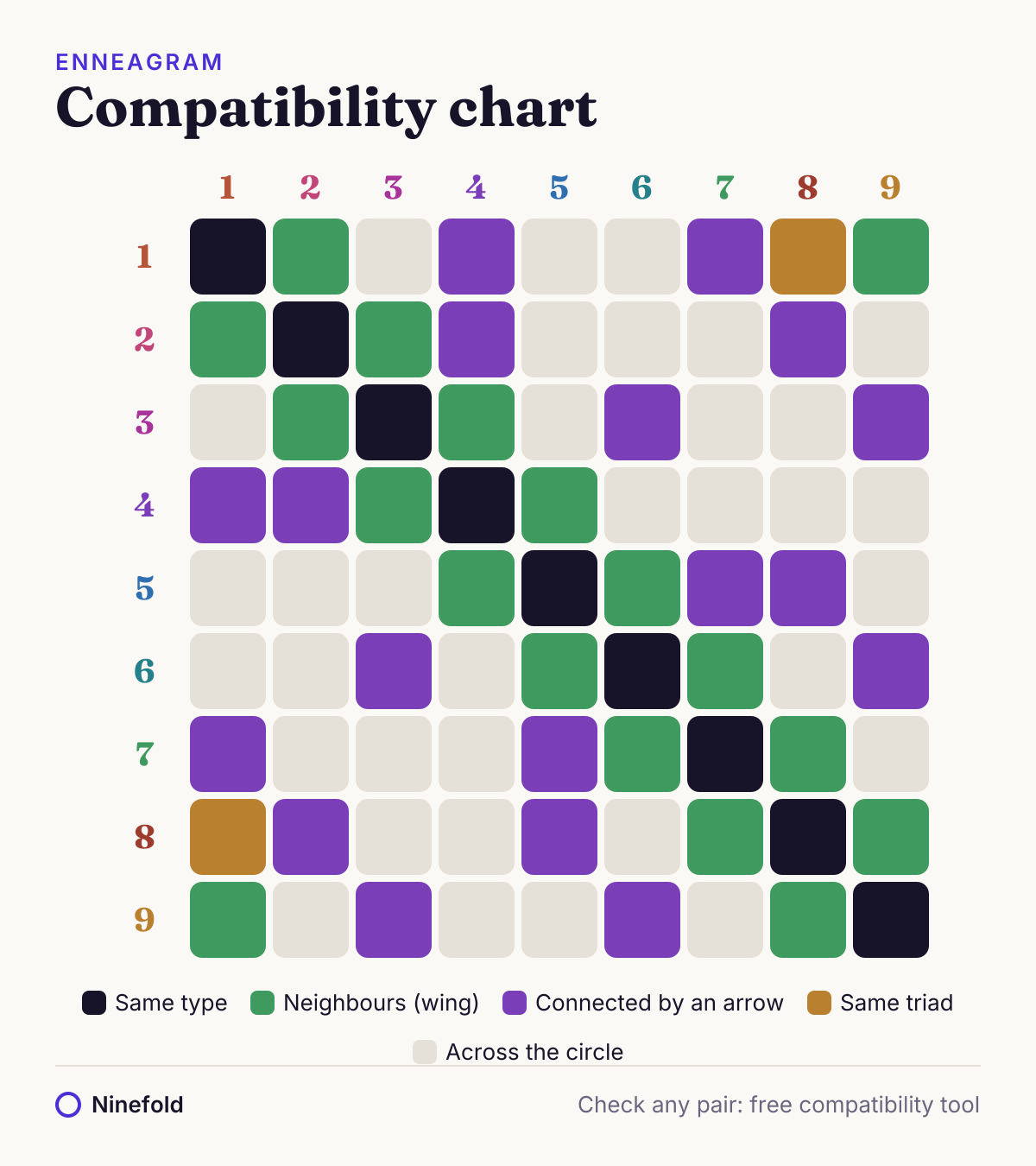
Each cell shows how two types connect. Of the 36 pairs of two different types, 9 are neighbours, 9 share an arrow, 1 shares a triad without a line, and 17 sit across the circle with no direct connection. Tap any cell to open that pair.
Five ways two types connect
Same type
Two people of the same type understand each other’s motives without explanation, and they share the same blind spot, so nobody in the pair points it out.
Neighbours (wing)
Neighbouring types share a border on the circle, and each can be the other’s wing. The pair usually feels familiar fast, and the differences show up later in what each one is protecting.
Connected by an arrow
A line runs between these types, so each one sees in the other a direction it moves toward under stress or in growth. That pull can feel magnetic, and it also means each partner shows the other their own stress pattern.
Same triad
Both types come from the same centre (gut, heart or head), so they react to the same kind of trigger with different strategies, which makes for empathy and for friction in the same moments.
Across the circle
These types share no line and no centre, so each brings something the other lacks. The work is translation: what feels obvious to one can be invisible to the other.
Compatibility by type
Each type page has a section on that type in relationships, with the patterns that help and the ones that hurt.
Enneagram compatibility FAQ
Which Enneagram types are most compatible?
No pairing is compatible or incompatible by type alone, and no study has shown that matching types predicts a happier relationship. What changes a relationship is how healthy each person is and whether each understands what the other is protecting. The chart shows how two types connect so you know where to look.
What does it mean when two types share an arrow?
A line runs between 9 pairs of types. Each partner shows the other a direction they move toward under stress or in growth, which can feel magnetic and can also mirror each other’s worst habits under pressure.
Are wing types good together?
Neighbouring types often feel familiar quickly because each carries some of the other’s traits. Their differences sit in the core motive, so conflicts tend to surface later, around what each person is protecting.
What about two people of the same type?
Same-type pairs understand each other’s motives without explanation and share the same blind spot. They do best when each partner has developed different strengths, often through their wings.
Do I need to know my partner’s type?
It helps, and guessing is error-prone because types are defined by motives you cannot see from outside. If you can, both take the free test and compare all nine scores, which shows more overlap than the top type alone.