Type 3 in brief
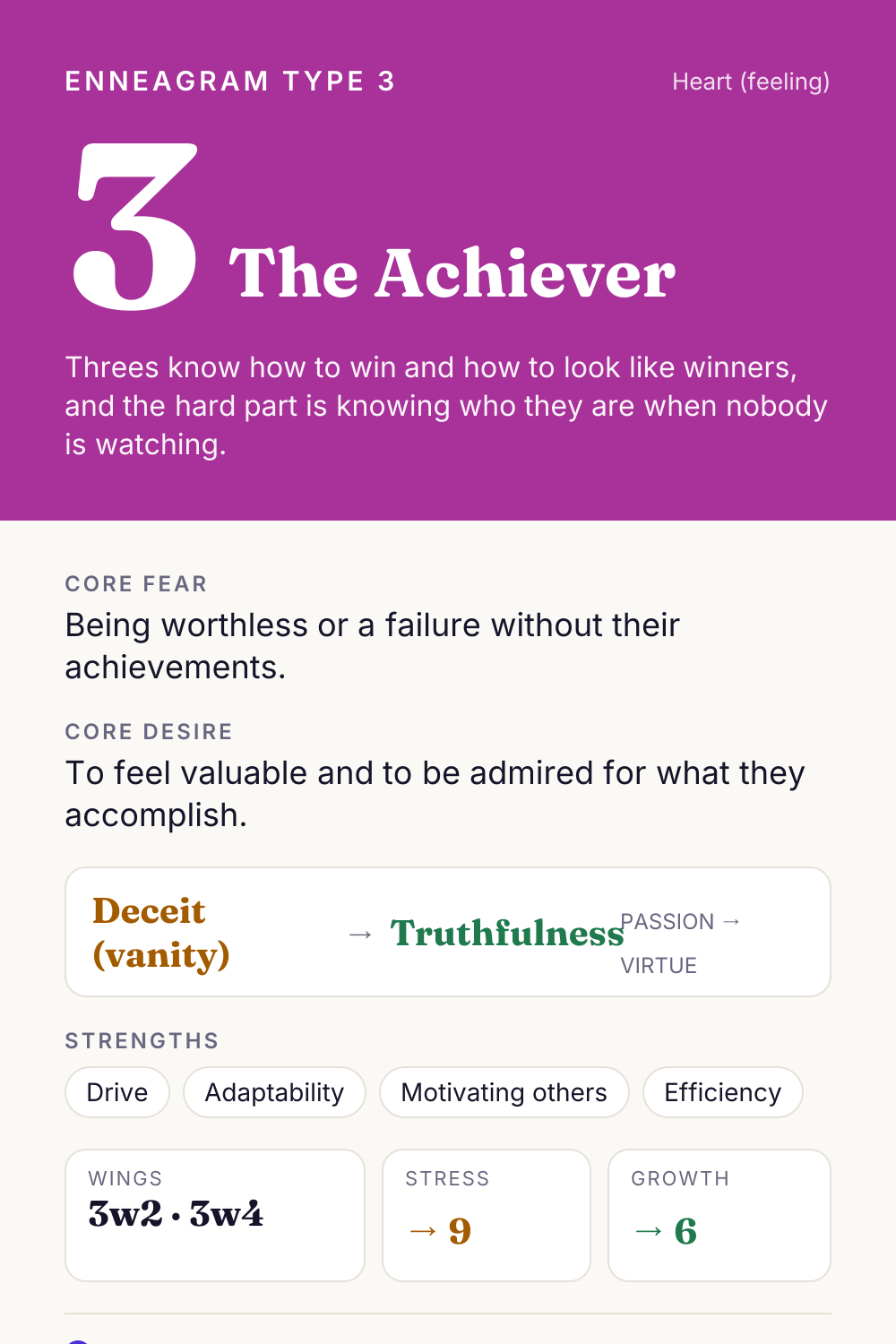
Type 3 sits in the heart triad with 2 and 4, the three types whose core issue is identity and image. A Two looks for worth in being needed and a Four in being authentic. A Three looks for it in being successful, so they read what a given audience admires and become the person who delivers it.
That skill makes Threes effective. They set goals, cut what does not serve them and keep momentum when others stall, and they can motivate a team because they believe the target is reachable. The same skill blurs their own feelings: emotions get parked until the project is done, and over time a Three can lose track of which ambitions are theirs and which belong to the room they are in.
- Fixation
- Holy idea
- Defense mechanism
- Childhood pattern
Type 3 at a glance
Am I a Type 3? A 2-minute check
Ten statements from our full test: five that measure Type 3 and five from the types most often confused with it (8, 7). Rate each from 1 (not me) to 5 (very me).
I set goals and keep track of my progress toward them.
Not meVery meI say what I think, even when it causes conflict.
Not meVery meI adjust how I come across depending on who I am with.
Not meVery meI stand up for people who are weaker or treated unfairly.
Not meVery meI feel uneasy when I am not being productive.
Not meVery meShowing vulnerability feels risky to me.
Not meVery meBeing seen as successful matters to me more than I usually admit.
Not meVery meI get bored quickly with routine.
Not meVery meI can put my feelings aside to get the job done.
Not meVery meI have more plans and ideas than time to do them.
Not meVery me
Type 3 strengths and struggles
Strengths
- Drive: they set a goal, break it down and keep moving when others stall.
- Adaptability: they read what a situation needs and adjust how they work and present.
- Motivating others: their belief that a target is reachable spreads through a team.
- Efficiency: they cut what does not serve the goal and get to results quickly.
- Presentation: they can explain an idea so that people want to back it.
Struggles
- Losing touch with feelings: emotions get parked until the project is done.
- Image management: polishing how things look, bad news included.
- Workaholism: rest feels like falling behind.
- Competitiveness that turns colleagues into rivals.
- Not knowing what they want once the audience is gone.
Signs you might be a Type 3
- You know your numbers, whether that means sales, followers, pace or grades, and you check them often.
- You can switch how you present yourself depending on the audience, and you do it without thinking.
- Downtime makes you restless unless it is building toward something.
- You feel a flash of panic when someone you consider a peer pulls ahead.
- You put feelings aside to get the job done and deal with them later, or never.
- Failure in public feels worse than almost anything else that could happen to you.
- People often tell you that you make things look easy.
- When someone asks how you are, you tend to answer with what you are working on.
Type 3 wings: 3w2 and 3w4
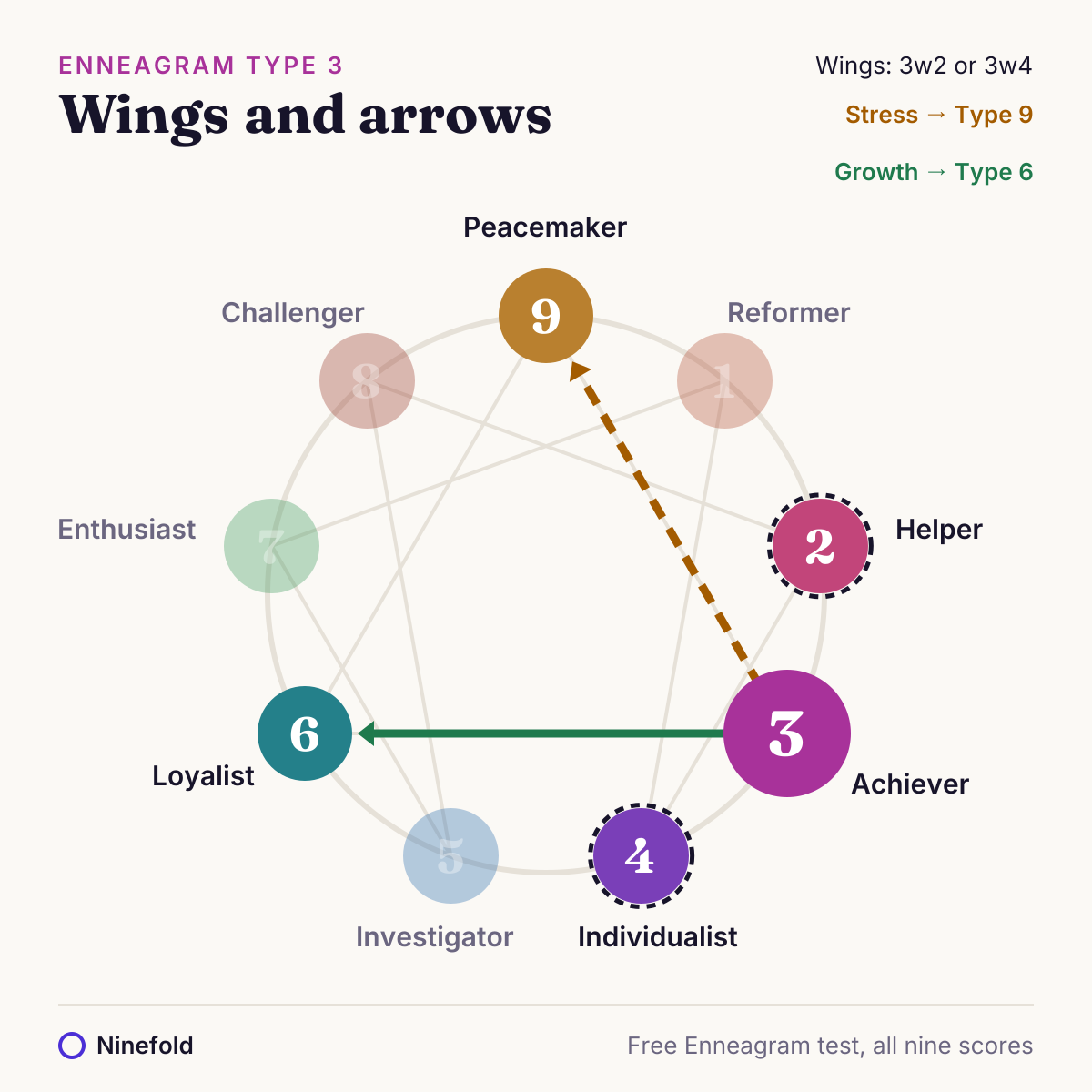
A wing is one of the two types next to yours on the circle. Most people lean toward one of them, and it colours how the core type shows up. Type 3’s neighbours are Type 2 and Type 4.
3w2, the Charmer
The Two wing adds warmth and social ease. 3w2s are sociable, likeable and good at winning people over, and they often succeed in roles where relationships drive results, such as sales, politics and management. The risk is that being liked becomes part of the scoreboard, and a 3w2 can bend themself to please whoever matters most at the time.
3w4, the Professional
The Four wing adds depth and a wish for the work to mean something personal. 3w4s are more reserved and more serious about craft, and they want to be admired for quality over popularity. The risk is a private swing between pride and shame, with the public face staying smooth while the inner critic grows louder.
| 3w2 | 3w4 | |
|---|---|---|
| Core drive | Be admired and liked for what they achieve | Be admired for work that means something |
| Social energy | Sociable, warm, networks easily | More reserved, selective about company |
| Creative style | Crowd-pleasing, made to connect | Distinctive, made to stand out on quality |
| At work | Sales, leadership, roles where people drive results | Craft, design, consulting, roles where expertise drives results |
| In love | Attentive and charming, wants to be the ideal partner | Loyal and intense, slower to show the inner self |
| Under stress | Pushes harder for approval and overcommits | Swings between pride and private shame |
| Growth edge | Find out what they want when it pleases nobody | Share the doubts behind the polished work |
3w2 or 3w4? Pick the truer statement in each pair.
0 of 6 picked.
The three Type 3 subtypes
Each type comes in three versions, depending on which instinct leads: self-preservation (safety and resources), social (belonging and standing) or one-to-one (intensity with one person). The subtype often changes how the type looks more than the wing does.
Self-preservation Three: security
The countertype, the Three who hides the vanity. Self-preservation Threes want admiration but avoid asking for it, and they aim to be good as well as to look good. They work hard, provide for others and value modesty, which is why they can mistype as One or Six.
Social Three: prestige
The most visible Three. Social Threes seek status, influence and recognition in the group, and they are the most competitive of the three subtypes. They know how to present well and climb, and they feel most at risk when they fall behind people they consider peers.
One-to-one (sexual) Three: charisma
The Three who promotes others. One-to-one Threes put their energy into supporting a partner or family and into being attractive to the people they love. They talk about other people’s success more than their own and can look like Twos.
Which instinct leads? Rate each statement.
- Not meVery me
- Not meVery me
- Not meVery me
Move all three sliders to see your lead instinct.
Type 3 in stress and growth
Stress: toward Type 9
Under stress a Three moves toward the average side of Nine. After pushing too long, they disengage: they go numb, procrastinate, lose motivation and drift through busywork or screens, unsure what they want once the goal stops pulling them.
Growth: toward Type 6
In growth a Three takes on the healthy side of Six: loyal, cooperative and committed to people and causes beyond their own success. Their energy goes into the team, and they gain the kind of trust that does not depend on their latest result.
What stress looks like
Type 3 → Type 9
- Goes numb and loses interest in the goals that drove them
- Procrastinates with busywork or screens
- Goes along with others to avoid more effort
- Feels unsure what they want once the push stops
What growth looks like
Type 3 → Type 6
- Commits to a team and shares the credit
- Admits a doubt or fear before it becomes a crisis
- Stays loyal to people when there is nothing to gain
- Asks for help and takes advice
Type 3 levels of development
The same type looks very different at its best and at its worst. The nine levels describe that range, from free and self-aware at level 1 to stuck and self-defeating at level 9. Stress, sleep and circumstance move people up and down the levels, so read them as a range you occupy.
- Level 1: Self-accepting and genuine. Their worth no longer depends on results, and they use their talents in service of something larger than their image.
- Level 2: Confident, adaptable and energetic, with a healthy sense of their own value that others find inspiring.
- Level 3: Ambitious and effective. They improve themselves and lift the people around them, and they make a strong role model.
- Level 4: Starts to compete for status. Hard-working and goal-driven, keen to stand out and anxious about falling behind.
- Level 5: Image-conscious and pragmatic. They package themselves for each audience and lose touch with what they feel.
- Level 6: Self-promoting and boastful, inflating their achievements and looking down on people who seem less successful.
- Level 7: Willing to bend the truth to keep up appearances. Dishonest and opportunistic, afraid of being exposed.
- Level 8: Deceptive and malicious toward anyone who threatens the image, sabotaging rivals to stay on top.
- Level 9: Obsessed with destroying whatever reminds them of their failure, with a risk of breakdown. Professional help is needed at this level.
Type 3 or another type? The common mistypes
Type 3 vs Type 8
Both are assertive, driven and comfortable in charge. An Eight wants control and independence and does not much care how they come across. A Three wants success and recognition and cares a great deal about how they come across. If you would sacrifice your image to keep control, you lean Eight; if you would soften to keep the image, you lean Three.
Type 3 vs Type 7
Both are upbeat, fast-moving and busy, with many projects on the go. A Seven chases experiences and options to avoid pain and boredom. A Three chases goals to prove their worth, and drops the fun if it gets in the way of the result. Ask whether you keep busy because it is enjoyable or because it counts.
Check yourself in under a minute:
Type 3 at work: careers that fit and jobs to avoid
Threes do their best work in roles with clear goals and visible results: sales, entrepreneurship, marketing, consulting, management, performance and competitive fields. They organise quickly, present well and keep a team pointed at the target.
They struggle in roles where success is vague or invisible, and in teams that punish ambition. A manager gets more from a Three by agreeing on measurable outcomes, recognising wins in specific terms, and making it safe to admit when something is failing early, because a Three will otherwise polish the status report.
Sales or business development
Founder or entrepreneur
Marketing or brand management
Management consulting
Team lead or general manager
Performer, presenter or athlete
Jobs that tend to drain a Four
What a Four needs from a job
Type 3 in relationships: compatibility with every type
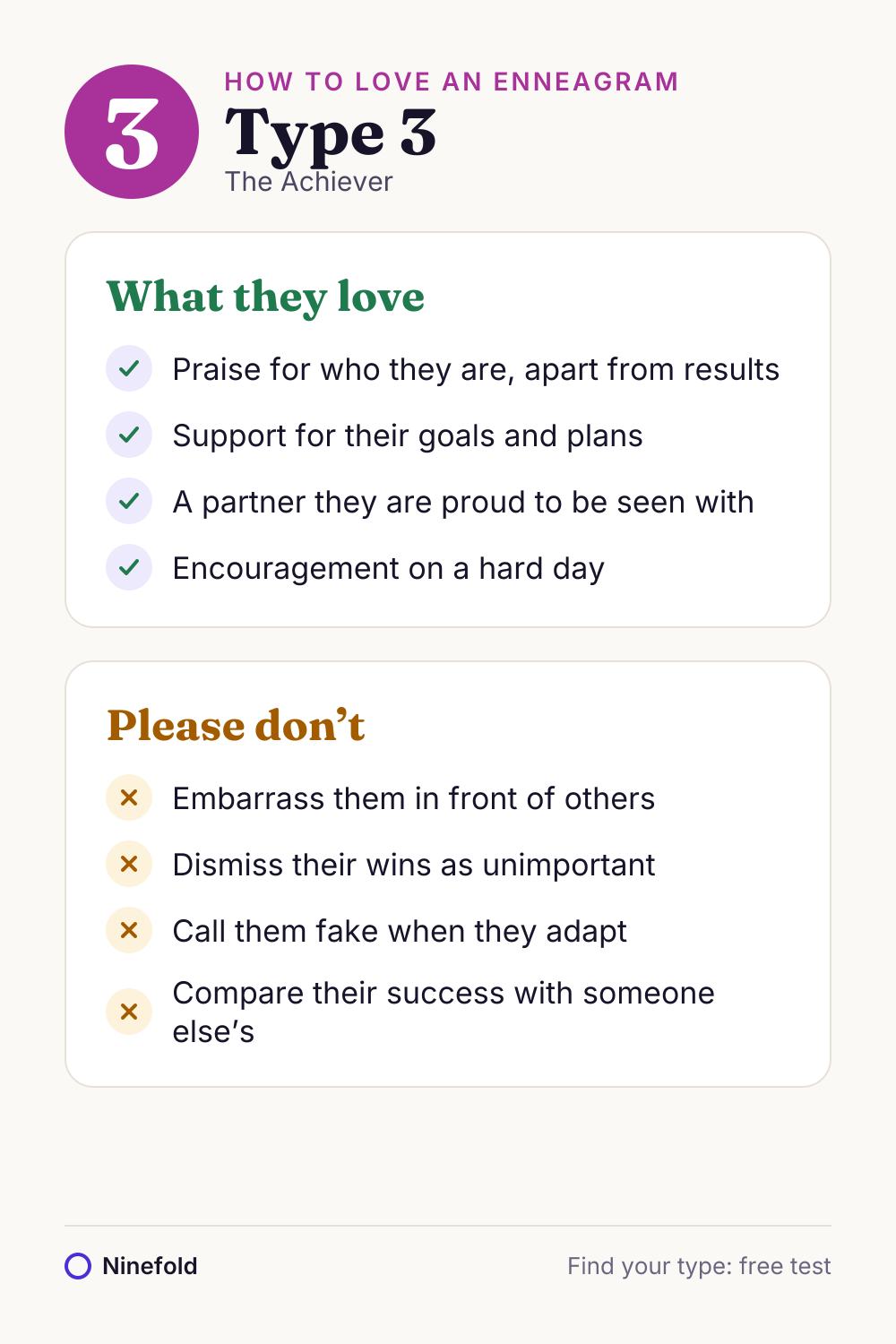
In relationships Threes are attentive, supportive and practical. They plan the trip, sort the logistics and want the partnership to look and feel successful, and they often push their partners to grow too.
The common trap is presenting the ideal partner while keeping the actual self out of reach, with work squeezing out time and feelings. Partners help by showing appreciation that has nothing to do with achievement, and Threes help by sharing what they feel before they have worked out how it sounds.
Type 3 and Type 1: The Reformer
Across the circleType 3 and Type 2: The Helper
Neighbours (wing)Type 3 and Type 3: The Achiever
Same typeType 3 and Type 4: The Individualist
Neighbours (wing)Type 3 and Type 5: The Investigator
Across the circleType 3 and Type 6: The Loyalist
Connected by an arrowType 3 and Type 7: The Enthusiast
Across the circleType 3 and Type 8: The Challenger
Across the circleType 3 and Type 9: The Peacemaker
Connected by an arrowSee how Type 3 pairs with each of the other eight on the Enneagram compatibility chart.
How Type 3 grows
- Once a day, ask yourself what you feel and wait for an answer before you move on.
- Do one thing each week that nobody will see, count or praise.
- Tell someone you trust about a failure while it is still fresh.
- Check whether a goal is yours by asking if you would still want it with no audience.
- Rest without tracking it. A run without a watch and a weekend without a plan both count.
A 7-day practice
What the Enneagram schools say about Type 3
The four main schools teach the same type with different emphasis. Where they disagree, this page follows the majority and names the exception.
| Topic | Where the schools agree | Where they differ |
|---|---|---|
| Name | Every school builds Type 3 around success, image and achievement. | Riso and Hudson call it the Achiever; Palmer and the Narrative tradition use the Performer; other teachers say the Motivator. |
| Passion and virtue | Deceit (self-deception) as the passion and truthfulness (veracity) as the virtue, a pairing that goes back to Ichazo and runs through Naranjo, Palmer and Chestnut. | Some teachers name the passion vanity; in Ichazo’s map vanity is the fixation and deceit the passion. Riso and Hudson put more weight on the self-image of being successful and admirable. |
| Stress and growth | The lines run to Nine and to Six. | Riso and Hudson read them as stress toward Nine and growth toward Six. Palmer calls Six the security point, where a Three goes when it feels safe. Chestnut teaches growth through the stress point: a Three grows by moving ahead to the healthy side of Nine to slow down and take others in, and back to Six to face fear. |
| Subtypes | Three instinctual versions of the type exist: self-preservation, social and one-to-one. | Naranjo and Chestnut give each subtype a name and a countertype (self-preservation Three). Riso and Hudson describe instinct stackings without the countertype idea. |
| Levels of development | Health changes how a type looks more than the type itself. | The nine-level scale is Riso and Hudson’s; other schools describe health in broader bands or not at all. |
- Riso, D. R., and Hudson, R. (1999). The Wisdom of the Enneagram. Bantam. ISBN 0553378201.
- Naranjo, C. (1994). Character and Neurosis. Gateways. ISBN 9780895560667.
- Palmer, H. (1988). The Enneagram. HarperSanFrancisco. ISBN 9780062506832.
- Chestnut, B. (2013). The Complete Enneagram. She Writes Press. ISBN 9781938314551.
Type 3 FAQ
What is an Enneagram type 3?
Type 3, often called the Achiever, is the personality pattern built around feeling valuable through success. Threes are ambitious, adaptable and image-aware, and their core fear is being worthless without their achievements.
What is the difference between 3w2 and 3w4?
3w2 is warmer and more sociable, and wins through charm and relationships. 3w4 is more reserved and craft-focused, and wants to be admired for the quality and originality of their work.
Where does a type 3 go in stress and growth?
In stress a Three moves toward Nine and becomes numb, unmotivated and disengaged. In growth a Three moves toward Six and becomes loyal, cooperative and committed to people beyond their own success.
What types are most often confused with type 3?
Types 8 and 7. Eights are also assertive and driven, but for control and with little interest in image, and Sevens are also busy and upbeat, though they chase experiences over results. The check on this page asks you to pick between their core motives.
How rare is Enneagram type 3?
No representative population study exists, so any percentage you see is a count of people who took one website’s test. Threes in particular may answer with the image they want to project, which makes self-reported results harder to trust. Treat rarity claims as marketing.
What are the type 3 subtypes?
Self-preservation Threes (security) work hard and avoid showing off, and they are the countertype; social Threes (prestige) chase status and are the most competitive; one-to-one Threes (charisma) put their drive into supporting a partner or family. The check on this page shows which instinct leads for you.
Who are Enneagram 3s most compatible with?
No type is a guaranteed match. Threes do best with partners who value them apart from their results, back their goals, and make it safe to admit doubt or failure. The pairs on this page show how a Three works with each of the nine types.
What jobs should a type 3 avoid?
Roles where success is vague or invisible: jobs with no measurable goals, back-office work nobody sees, slow consensus-driven cultures, and teams that punish ambition. Threes do their best work with clear targets and recognition.
Do Enneagram 3s get jealous?
Like anyone, yes, and the form typical of the type is competitive: when a peer pulls ahead, a Three can feel their own worth slipping. Naming the comparison, and asking whether they want the thing for themselves or for the audience, takes the sting out.
Is there an MBTI type for Enneagram 3?
No fixed one. The MBTI sorts how you take in information and decide; the Enneagram sorts what motivates you. Threes are often linked with ENTJ and ESTJ because those types also focus on goals and efficiency, and a Three can still be any MBTI type.
Which famous people are Enneagram type 3?
Typing a public figure means guessing their private motives, so every list online is speculation. We do not publish one. The self-check on this page is a better guide to whether you are a Three than any celebrity comparison.