Type 2 in brief
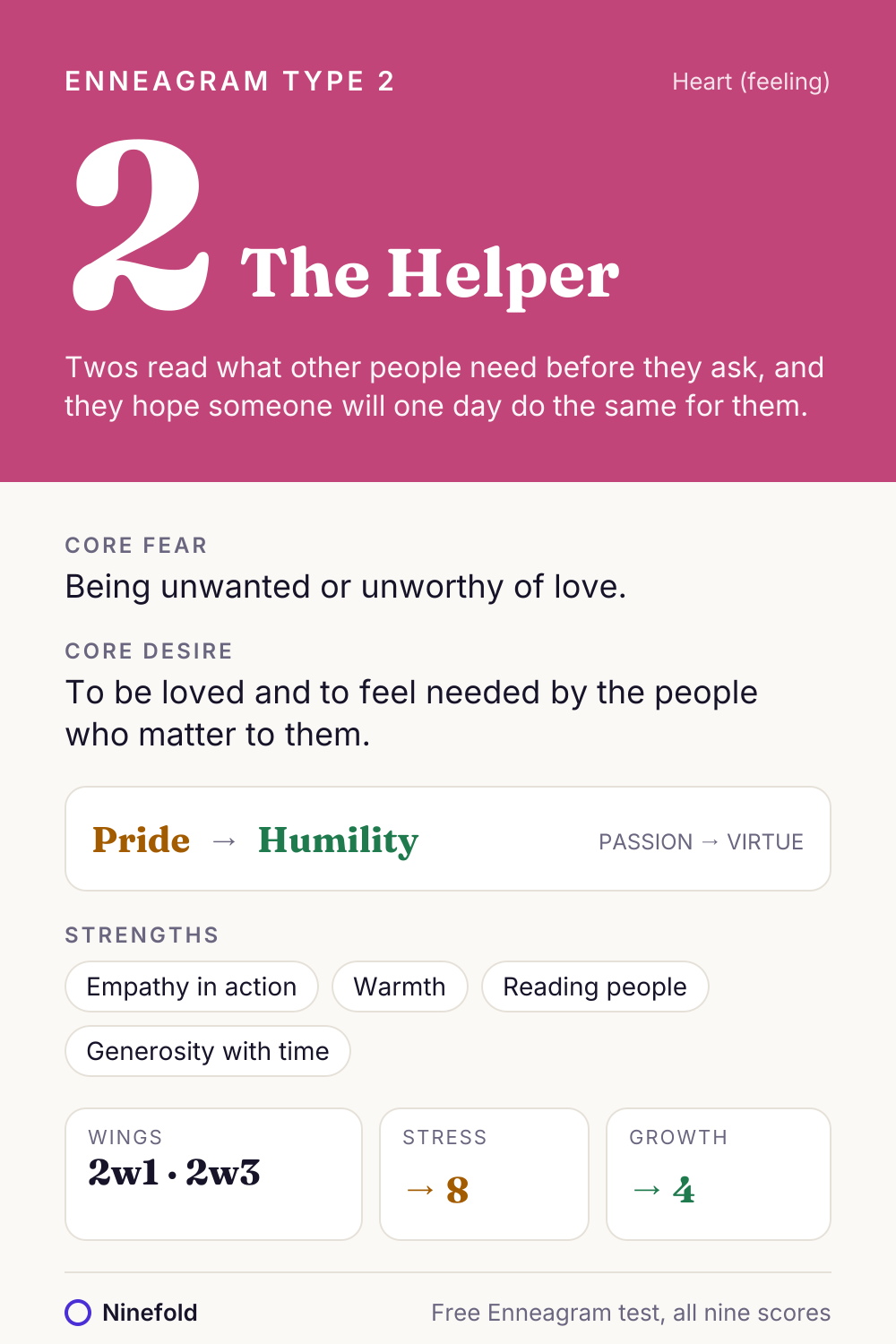
Type 2 sits in the heart triad with 3 and 4, the three types whose core issue is identity and image. A Three looks for worth in being admired and a Four in being authentic. A Two looks for it in being needed, so their attention moves outward to other people’s moods and gaps, and they adjust themselves to fill them.
That outward attention makes Twos generous, warm and quick to act when someone is struggling. They remember birthdays, notice who left the party early and know what a friend wants before the friend does. The same habit keeps their own needs out of view, and when the giving goes unthanked, the hurt comes out sideways as complaints, guilt or a quiet record of everything they did.
- Fixation
- Holy idea
- Defense mechanism
- Childhood pattern
Type 2 at a glance
Am I a Type 2? A 2-minute check
Ten statements from our full test: five that measure Type 2 and five from the types most often confused with it (9, 7). Rate each from 1 (not me) to 5 (very me).
I sense what other people need before they say it.
Not meVery meI go along with others to keep the peace.
Not meVery meI find it easier to give help than to ask for it.
Not meVery meI lose track of my own priorities when other people want things from me.
Not meVery meI feel hurt when the care I give goes unnoticed.
Not meVery meComfortable routines help me feel settled.
Not meVery mePeople often come to me with their problems.
Not meVery meI get bored quickly with routine.
Not meVery meI sometimes say yes to people when I mean no.
Not meVery meI have more plans and ideas than time to do them.
Not meVery me
Type 2 strengths and struggles
Strengths
- Empathy in action: they notice what someone needs and do something about it the same day.
- Warmth: people feel welcome and remembered around them.
- Reading people: they pick up mood, tension and unspoken needs faster than most.
- Generosity with time: they show up for the house move, the hospital visit and the late phone call.
- Connection: they introduce people, remember details and hold groups together.
Struggles
- Hidden needs: they struggle to say what they want, then feel hurt when nobody guesses.
- Giving to get: help can carry an unspoken expectation of thanks or closeness.
- Saying no: refusing a request feels like putting the relationship at risk.
- Pride: the belief that they need others less than others need them.
- Resentment and guilt-tripping once the giving goes unnoticed.
Signs you might be a Type 2
- You can tell when someone in the room is upset, often before they say a word.
- Saying no to a request feels selfish, even when you have no time left.
- You find it far easier to give help than to ask for it.
- You change a little depending on who you are with, because you want each person to feel comfortable.
- You keep an unspoken count of what you have done for people, and it hurts when they do not notice.
- When someone asks what you want, your first answer is what they want.
- Being left out stings more than being criticised.
- You feel most valuable when someone tells you they could not have managed without you.
Type 2 wings: 2w1 and 2w3
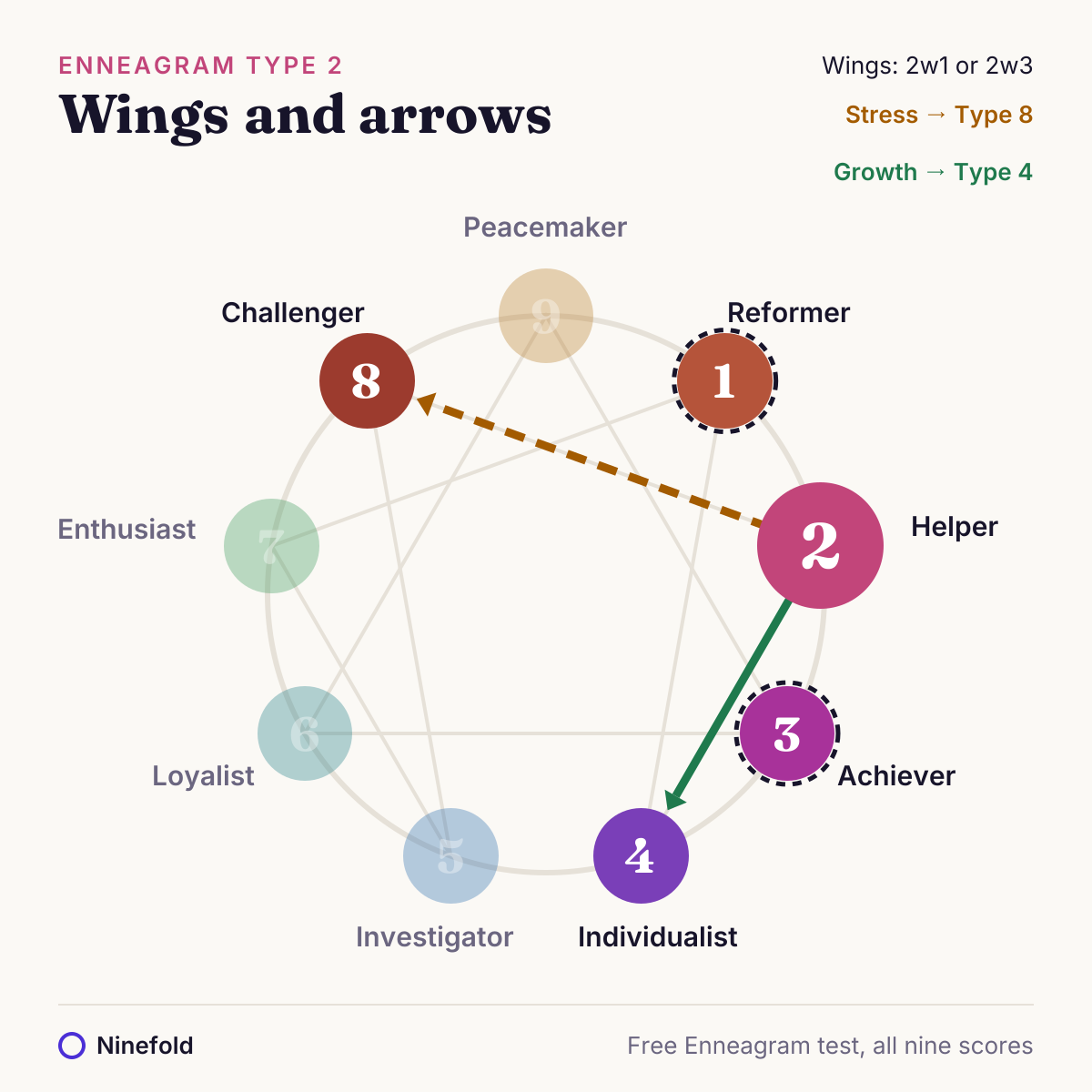
A wing is one of the two types next to yours on the circle. Most people lean toward one of them, and it colours how the core type shows up. Type 2’s neighbours are Type 1 and Type 3.
2w1, the Servant
The One wing adds principle and restraint. 2w1s help out of duty as much as warmth, so they gravitate to service roles such as nursing, teaching and care work, and they hold back from the spotlight. The risk is self-criticism: they judge their own needs as selfish and can resent people who take without giving back.
2w3, the Host/Hostess
The Three wing adds charm and social ambition. 2w3s are outgoing, polished and good at bringing people together, and they enjoy being the one everyone likes. The risk is that helping turns into a performance, and a 2w3 can measure their worth by the size of their circle and the attention it gives back.
| 2w1 | 2w3 | |
|---|---|---|
| Core drive | Be loved by being good and of service | Be loved by being liked and admired |
| Social energy | Quieter, prefers one-to-one care | Outgoing, at ease in a crowd |
| Creative style | Practical help, done properly and without fuss | Hosting and gestures that make people feel special |
| At work | Nursing, teaching, support roles; shies away from credit | Sales, events, people management; enjoys visible roles |
| In love | Devoted and dutiful, hard on their own needs | Affectionate and charming, wants to be the favourite |
| Under stress | Turns critical and martyr-like | Turns hungry for attention and competitive |
| Growth edge | Treat their own needs as legitimate without building a moral case | Help where nobody will see it |
2w1 or 2w3? Pick the truer statement in each pair.
0 of 6 picked.
The three Type 2 subtypes
Each type comes in three versions, depending on which instinct leads: self-preservation (safety and resources), social (belonging and standing) or one-to-one (intensity with one person). The subtype often changes how the type looks more than the wing does.
Self-preservation Two: privilege
The countertype, the Two whose pride is hardest to see. Self-preservation Twos want to be cared for, and they draw that care with a youthful, playful and charming manner. They want to be loved for who they are more than for what they give, and many do not recognise themselves in the classic helper description.
Social Two: ambition
The Two who wins over a group. Social Twos charm rooms, teams and communities, and they like being on top, influential and close to the people who matter. Their giving tends to be strategic, and they can look like Threes.
One-to-one (sexual) Two: seduction-aggression
The classic seductive Two. One-to-one Twos focus on a specific person and pursue them with attention, charm and devotion, and when they meet rejection the warmth can flip into anger. They want a partner who meets every need and are the most intense of the Twos.
Which instinct leads? Rate each statement.
- Not meVery me
- Not meVery me
- Not meVery me
Move all three sliders to see your lead instinct.
Type 2 in stress and growth
Stress: toward Type 8
Under stress a Two moves toward the average side of Eight. When their giving goes unnoticed, the warmth flips into confrontation: they become blunt, controlling and openly angry, and they tell people exactly what they owe.
Growth: toward Type 4
In growth a Two takes on the healthy side of Four: honest about their own feelings and needs, and able to spend time on themself without guilt. Helping turns into a choice, which makes it lighter for both the Two and the person receiving it.
What stress looks like
Type 2 → Type 8
- Turns blunt and demanding when the giving is not returned
- Keeps score openly and tells people what they owe
- Tries to control the people they feel responsible for
- Shows anger they normally hide behind warmth
What growth looks like
Type 2 → Type 4
- Names their own feelings before asking about anyone else’s
- Spends time on something only they care about
- Says no without a long explanation
- Lets someone see that they are hurt or in need
Type 2 levels of development
The same type looks very different at its best and at its worst. The nine levels describe that range, from free and self-aware at level 1 to stuck and self-defeating at level 9. Stress, sleep and circumstance move people up and down the levels, so read them as a range you occupy.
- Level 1: Loves without strings attached. They care for others and for themself with equal ease, and giving no longer needs anything back.
- Level 2: Warm, empathetic and attuned to people, with a genuine interest in others that leaves room for their own life.
- Level 3: Generous and encouraging, the friend who shows up with practical help and makes people feel valued.
- Level 4: Starts to give in order to be close. Friendly and effusive, keen to be liked, and attentive to who appreciates them.
- Level 5: Becomes possessive and intrusive. They need to be needed, so they stay involved in other people’s affairs and want credit for it.
- Level 6: Self-important about their sacrifices. Help comes with reminders, and they feel entitled to gratitude they have not been given.
- Level 7: Manipulative and guilt-tripping. They use the debts others owe them to get what they want and can turn bitter fast.
- Level 8: Feels entitled to anything in return for what they have given, and can act coercively while still seeing themself as the victim.
- Level 9: Physical and emotional collapse, often expressed through illness that forces others to care for them. Professional help is needed at this level.
Type 2 or another type? The common mistypes
Type 2 vs Type 9
Both are agreeable, accommodating and good at putting others first. A Nine goes along with people to keep the peace and avoid friction, and their attention is diffuse. A Two goes toward people to be close and appreciated, and their attention is sharp and specific. If you merge to stay comfortable, you lean Nine; if you give to be valued, you lean Two.
Type 2 vs Type 7
Both are sociable, upbeat and energetic in a group. A Seven is focused on their own experience and keeping options open, and people are part of the fun. A Two is focused on other people’s experience and on being important to them. Ask whether you light up because the evening is exciting or because the people in it are happy with you.
Check yourself in under a minute:
Type 2 at work: careers that fit and jobs to avoid
Twos do their best work where people are the point: healthcare, teaching, coaching, HR, hospitality, customer success, and assistant or chief-of-staff roles where knowing what a leader needs is the job. They build the relationships that make teams function and notice burnout early.
They struggle in cold, transactional cultures or roles with no human contact. A manager gets more from a Two by thanking them specifically and personally, and by checking that they are not quietly carrying three colleagues’ workloads, because a Two will rarely say so before they are exhausted.
Nurse, midwife or caregiver
Teacher or school counsellor
Coach or therapist
HR, people operations or customer success
Executive assistant or chief of staff
Hospitality or event management
Jobs that tend to drain a Four
What a Four needs from a job
Type 2 in relationships: compatibility with every type
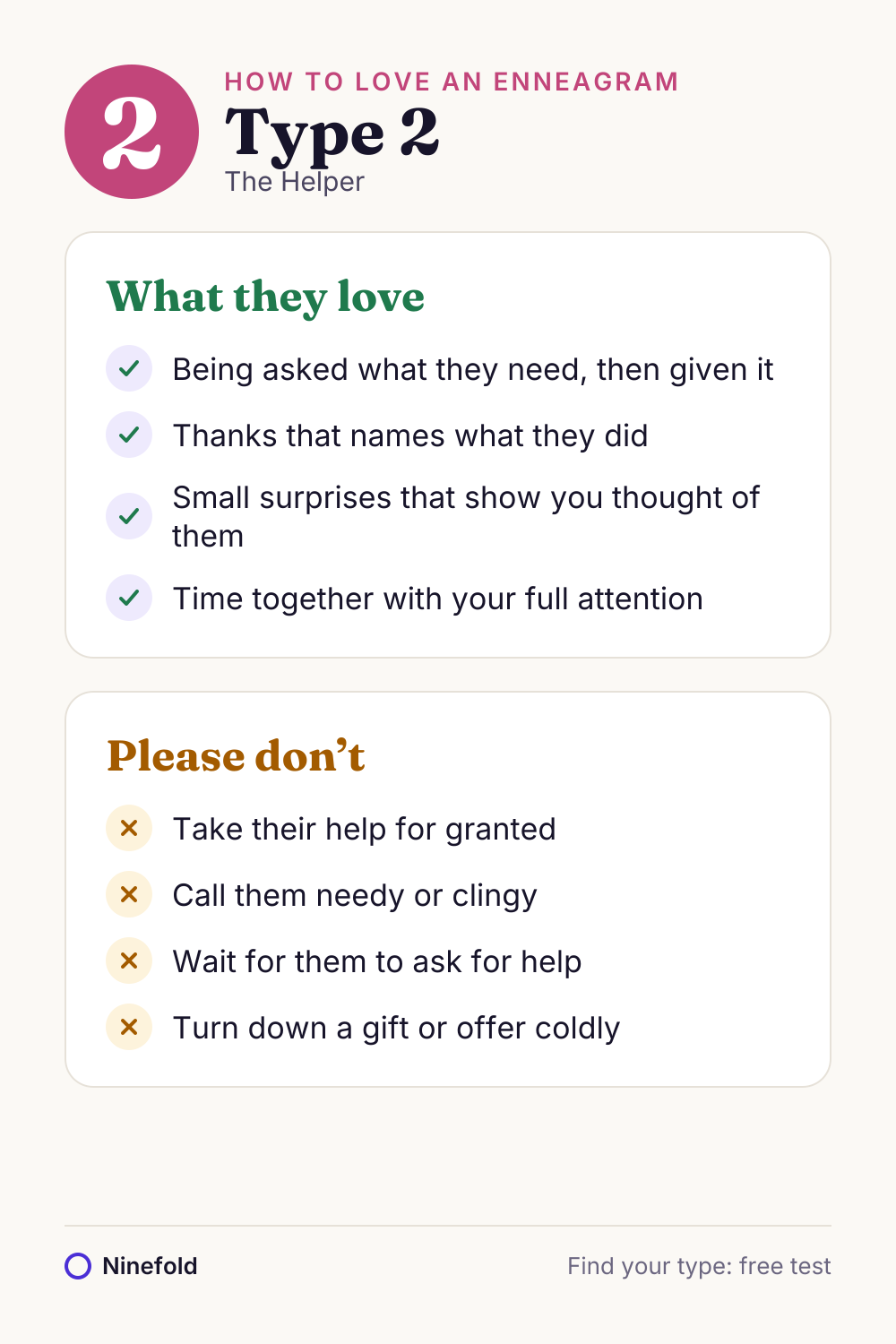
In relationships Twos are attentive, affectionate and generous with time and practical care. They remember the details of a partner’s day and anticipate what will make it easier, often before the partner knows.
The common trap is unspoken exchange: giving in the hope of being given to, then feeling hurt when the partner did not guess. Partners help by asking a Two directly what they want and waiting for a true answer, and Twos help by stating needs plainly and letting care arrive in forms they did not choose.
Type 2 and Type 1: The Reformer
Neighbours (wing)Type 2 and Type 2: The Helper
Same typeType 2 and Type 3: The Achiever
Neighbours (wing)Type 2 and Type 4: The Individualist
Connected by an arrowType 2 and Type 5: The Investigator
Across the circleType 2 and Type 6: The Loyalist
Across the circleType 2 and Type 7: The Enthusiast
Across the circleType 2 and Type 8: The Challenger
Connected by an arrowType 2 and Type 9: The Peacemaker
Across the circleSee how Type 2 pairs with each of the other eight on the Enneagram compatibility chart.
How Type 2 grows
- Before you offer help, pause and ask yourself what you are hoping to get back.
- Practise saying one small no each week and notice that the relationship survives it.
- Write down three things you need this week, then ask someone for one of them.
- Spend time alone doing something only you enjoy, with nobody to look after.
- When resentment shows up, treat it as a sign that you gave past what you wanted to give.
A 7-day practice
What the Enneagram schools say about Type 2
The four main schools teach the same type with different emphasis. Where they disagree, this page follows the majority and names the exception.
| Topic | Where the schools agree | Where they differ |
|---|---|---|
| Name | Every school builds Type 2 around love, giving and the needs of others. | Riso and Hudson call it the Helper; Palmer and the Narrative tradition use the Giver; other teachers say the Caretaker. |
| Passion and virtue | Pride as the passion and humility as the virtue, a pairing that goes back to Ichazo and runs through Naranjo, Palmer and Chestnut. | Riso and Hudson put more weight on the self-image of being loving and caring than on pride as the driver. |
| Stress and growth | The lines run to Eight and to Four. | Riso and Hudson read them as stress toward Eight and growth toward Four. Palmer calls Four the security point, where a Two goes when it feels safe. Chestnut teaches growth through the stress point: a Two grows by moving ahead to the healthy side of Eight to own their power and needs, and back to Four to reclaim feeling. |
| Subtypes | Three instinctual versions of the type exist: self-preservation, social and one-to-one. | Naranjo and Chestnut give each subtype a name and a countertype (self-preservation Two). Riso and Hudson describe instinct stackings without the countertype idea. |
| Levels of development | Health changes how a type looks more than the type itself. | The nine-level scale is Riso and Hudson’s; other schools describe health in broader bands or not at all. |
- Riso, D. R., and Hudson, R. (1999). The Wisdom of the Enneagram. Bantam. ISBN 0553378201.
- Naranjo, C. (1994). Character and Neurosis. Gateways. ISBN 9780895560667.
- Palmer, H. (1988). The Enneagram. HarperSanFrancisco. ISBN 9780062506832.
- Chestnut, B. (2013). The Complete Enneagram. She Writes Press. ISBN 9781938314551.
Type 2 FAQ
What is an Enneagram type 2?
Type 2, often called the Helper, is the personality pattern built around being loved by being needed. Twos are warm, generous and attuned to other people, and their core fear is being unwanted or unworthy of love.
What is the difference between 2w1 and 2w3?
2w1 is more reserved and duty-driven, helps behind the scenes and judges their own needs harshly. 2w3 is more outgoing and socially ambitious, enjoys being liked by many people and helps in visible ways.
Where does a type 2 go in stress and growth?
In stress a Two moves toward Eight and becomes blunt, controlling and openly angry about what they are owed. In growth a Two moves toward Four and becomes honest about their own feelings and needs.
What types are most often confused with type 2?
Types 9 and 7. Nines also accommodate others, but to keep the peace, and Sevens are also sociable, though the focus stays on their own experience. The check on this page asks you to pick between their core motives.
How rare is Enneagram type 2?
No representative population study exists, so any percentage you see is a count of people who took one website’s test. Many Twos also describe the person they want to be for others when they answer, which makes self-typing less reliable. Treat rarity claims as marketing.
What are the type 2 subtypes?
Self-preservation Twos (privilege) want to be cared for and use charm to get it, and they are the countertype; social Twos (ambition) win over groups and like to be influential; one-to-one Twos (seduction-aggression) pursue one person with full devotion. The check on this page shows which instinct leads for you.
Who are Enneagram 2s most compatible with?
No type is a guaranteed match. Twos do best with partners who notice their needs without being asked, say thank you in specific terms and let the Two receive care as well as give it. The pairs on this page show how a Two works with each of the nine types.
What jobs should a type 2 avoid?
Roles with no human contact or no thanks: solo technical work, cold transactional sales, jobs where effort goes unacknowledged, and collections work that sets them against the people they want to help.
Are type 2s manipulative?
Manipulation belongs to the unhealthy end of the type. At average levels a Two can give in order to get closeness or thanks, and under pressure that can turn into guilt-tripping. Healthy Twos give freely and say what they need directly, which removes the reason to manipulate.
Is there an MBTI type for Enneagram 2?
No fixed one. The MBTI sorts how you take in information and decide; the Enneagram sorts what motivates you. Twos are often linked with ESFJ and ENFJ because those types also centre on harmony and other people’s needs, and a Two can still be any MBTI type.
Which famous people are Enneagram type 2?
Typing a public figure means guessing their private motives, so every list online is speculation. We do not publish one. The self-check on this page is a better guide to whether you are a Two than any celebrity comparison.