Type 6 in brief
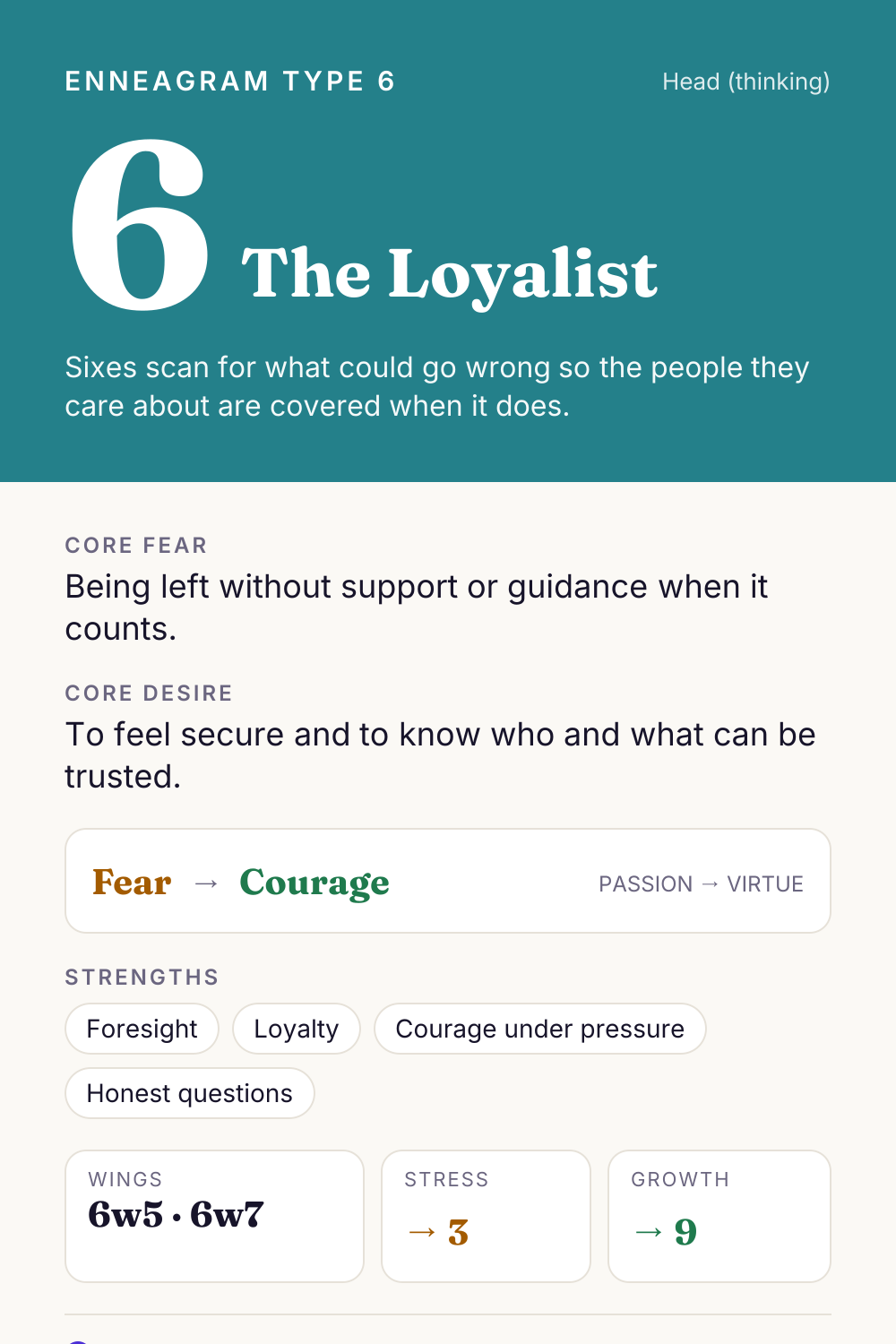
Type 6 sits in the head triad with 5 and 7, the three types organised around fear and the search for security. A Five handles fear by retreating into knowledge and a Seven by moving toward the next option, while a Six stays in the room and tests it: the plan, the authority, the friend, and their own read of all three.
That testing makes Sixes the people who spot the flaw in the contract and the colleague who has gone quiet. It also means their mind keeps running scenarios after everyone else has stopped, and the same doubt they aim at others turns back on their own decisions. Some Sixes move toward the threat to prove they are unafraid, which is why the type can look timid in one person and confrontational in the next.
- Fixation
- Holy idea
- Defense mechanism
- Childhood pattern
Type 6 at a glance
Am I a Type 6? A 2-minute check
Ten statements from our full test: five that measure Type 6 and five from the types most often confused with it (1, 4, 9). Rate each from 1 (not me) to 5 (very me).
I think through what could go wrong before I commit.
Not meVery meI notice what is wrong or could be done better almost everywhere I look.
Not meVery meI look for people and systems I can trust.
Not meVery meI feel a quiet anger when people ignore the rules that keep things fair.
Not meVery meI question authority, and I also want to be able to rely on it.
Not meVery meI am drawn to beauty, melancholy and things with emotional depth.
Not meVery meDoubt often stops me from trusting my own judgment.
Not meVery meI long for things I do not have, or for times that are gone.
Not meVery meI stay loyal to the groups and people I have chosen.
Not meVery meI lose track of my own priorities when other people want things from me.
Not meVery me
Type 6 strengths and struggles
Strengths
- Foresight: they spot the gap in the plan while there is still time to fix it.
- Loyalty: once they commit to a person, team or cause, they stay through the hard years.
- Courage under pressure: in a crisis they act, and they act for the people around them.
- Honest questions: they ask what others are too polite or too confident to ask.
- Building trust: they keep their word, and over time whole teams start to rely on it.
Struggles
- Overthinking: running scenarios long after a decision needed to be made.
- Testing people: probing a partner or boss for proof of loyalty until the test causes the doubt it was meant to settle.
- Ambivalence toward authority: wanting a strong leader and distrusting every leader they get.
- Asking for advice, then doubting it: collecting opinions as a way to postpone their own call.
- Reactivity: a sudden swing into suspicion or blame when they feel cornered.
Signs you might be a Type 6
- You plan for the worst case so you can relax about everything else.
- You trust people slowly, and once you do, you stay loyal through hard years.
- You ask for other opinions on a decision, then distrust the advice once you have it.
- Authority makes you uneasy in both directions: you want someone reliable in charge and you watch them for signs they are not.
- Your mind runs "what if" chains at night that it does not run in daylight.
- You notice when the mood in a room shifts before anyone says a word.
- You are often the person who calms others in a crisis, then shakes once it is over.
- Being caught unprepared bothers you more than being wrong.
Type 6 wings: 6w5 and 6w7
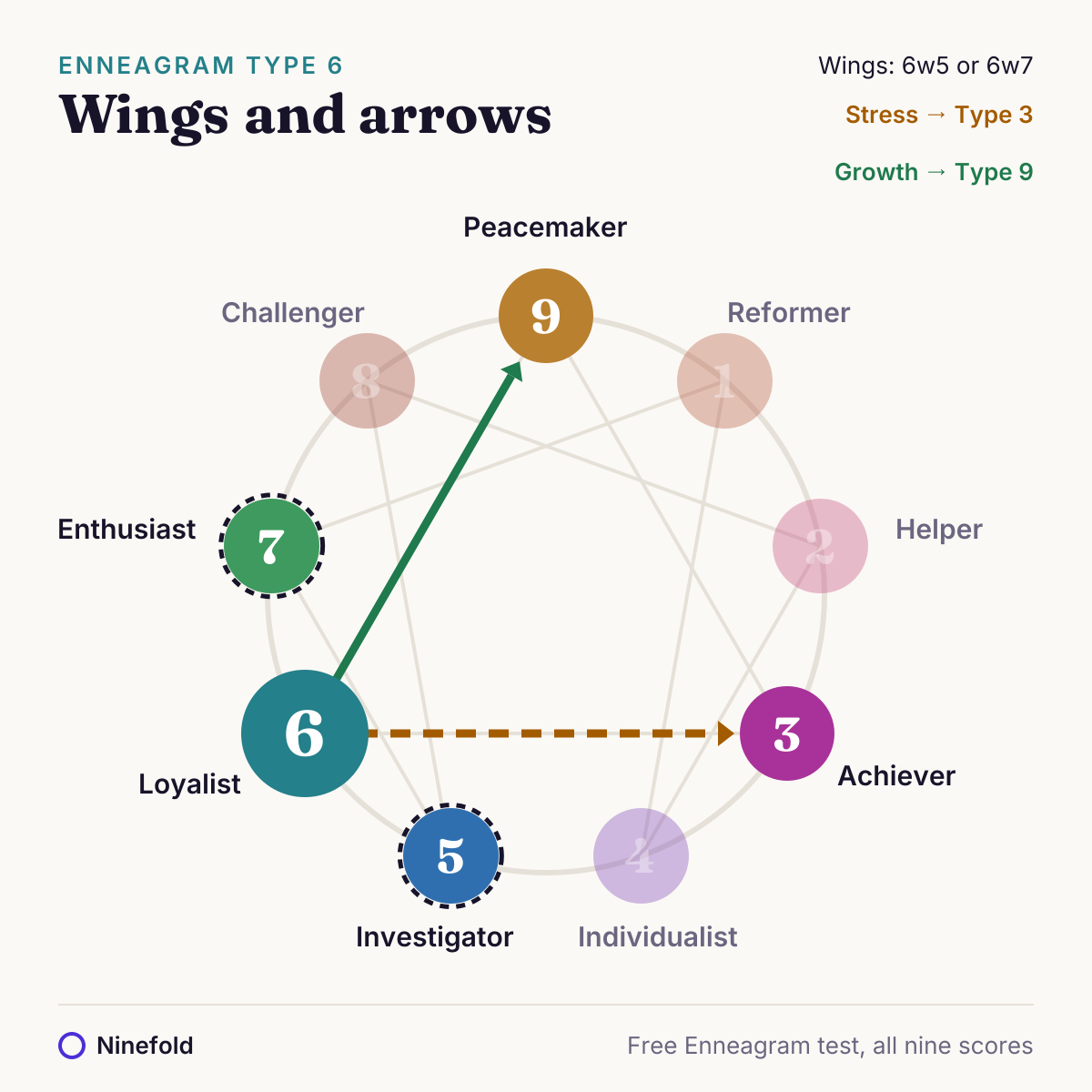
A wing is one of the two types next to yours on the circle. Most people lean toward one of them, and it colours how the core type shows up. Type 6’s neighbours are Type 5 and Type 7.
6w5, the Defender
The Five wing adds a need to understand the threat before trusting anyone with it. 6w5s are more reserved, more analytical and more independent, often loyal to a cause, a field of expertise or a set of principles. The risk is a fortress mindset: so much research and suspicion that few people are ever let inside.
6w7, the Buddy
The Seven wing adds warmth, humour and a pull toward people. 6w7s are more sociable and playful and often handle anxiety by staying busy and connected, which makes them easy to like and quick to commit. The risk is scattered energy and a habit of seeking reassurance from many people at once.
| 6w5 | 6w7 | |
|---|---|---|
| Core drive | Understand the threat before trusting anyone with it | Stay connected so nobody faces the threat alone |
| Social energy | Reserved, selective, needs time alone to think | Warm, talkative, recharges with friends |
| Handling anxiety | Researches, prepares, builds a fortress of facts | Keeps busy, jokes, seeks reassurance from several people |
| At work | Analytical, independent, loyal to a field or principle | Team-minded, energetic, loyal to the people in it |
| In love | Slow to open up, steady once committed | Quick to commit, needs frequent signs it is still safe |
| Under stress | Withdraws and gets suspicious of outsiders | Scatters, overcommits and grows restless |
| Growth edge | Let people in before every risk is understood | Trust their own judgement without polling everyone |
6w5 or 6w7? Pick the truer statement in each pair.
0 of 6 picked.
The three Type 6 subtypes
Each type comes in three versions, depending on which instinct leads: self-preservation (safety and resources), social (belonging and standing) or one-to-one (intensity with one person). The subtype often changes how the type looks more than the wing does.
Self-preservation Six: warmth
The most openly fearful Six. Self-preservation Sixes look for safety in friendly alliances, so they make themselves warm, likeable and easy to trust in the hope that others will protect them. They find it hard to be angry or to take a clear position, and they doubt themselves more than they doubt other people.
Social Six: duty
Fear managed through rules, reason and a clear frame of reference. Social Sixes look for the right authority, ideology or set of procedures and hold to it carefully, because knowing the rules shows them where the safe ground is. They are precise, dutiful and can look like Ones, though the motive is security where a One is chasing correctness.
One-to-one (sexual) Six: strength and beauty
The countertype, the Six that looks least afraid. One-to-one Sixes go against their fear by becoming strong, bold and sometimes intimidating, working on the idea that the best defence is to move first. They take risks, challenge authority and can look like Eights, though the boldness covers doubt they still feel inside.
Which instinct leads? Rate each statement.
- Not meVery me
- Not meVery me
- Not meVery me
Move all three sliders to see your lead instinct.
Type 6 in stress and growth
Stress: toward Type 3
Under stress a Six moves toward the average side of Three: they throw themselves into work and image, become competitive and image-conscious, and try to prove their worth through output so nobody can call them weak or unreliable.
Growth: toward Type 9
In growth a Six takes on the healthy side of Nine: relaxed, receptive and able to trust that things can turn out fine without constant monitoring. The inner alarm quiets, and the energy that went into vigilance goes into the people and work in front of them.
What stress looks like
Type 6 → Type 3
- Throws themselves into work to prove they are not weak
- Starts caring a lot about how they look to the boss or group
- Competes with colleagues they used to see as allies
- Measures their worth by output and visible results
What growth looks like
Type 6 → Type 9
- Lets a decision stand without asking three more people
- Feels calm in the body before the facts are all in
- Gives others the benefit of the doubt by default
- Puts the energy from vigilance into people and work
Type 6 levels of development
The same type looks very different at its best and at its worst. The nine levels describe that range, from free and self-aware at level 1 to stuck and self-defeating at level 9. Stress, sleep and circumstance move people up and down the levels, so read them as a range you occupy.
- Level 1: Trusts themself and others from a settled place. Courage comes from inside, and their loyalty gives people room to grow.
- Level 2: Warm, reliable and engaging. Others feel safe around them because they keep their word.
- Level 3: Committed and hardworking. Builds teams, systems and communities that hold up under pressure.
- Level 4: Starts looking outward for security. Invests heavily in allies, rules and institutions and worries about losing them.
- Level 5: Ambivalent and defensive. Swings between obedience and defiance, and procrastinates on choices that feel risky.
- Level 6: Suspicious and reactive. Blames others, takes sides hard and treats disagreement as betrayal.
- Level 7: Feels unprotected and panics. Clings to a strong figure or lashes out at perceived enemies.
- Level 8: Paranoid. Sees threats everywhere and may act on distorted conclusions about the people around them.
- Level 9: Self-destructive under the weight of anxiety and helplessness. Professional help is needed at this level.
Type 6 or another type? The common mistypes
Type 6 vs Type 1
Both like rules, follow through and can be critical. A One holds an inner standard of right and wrong and gets angry when it is broken. A Six follows rules because they offer safety and gets anxious when the ground feels uncertain. If you check the plan because it must be correct, you lean One; if you check it because something could go wrong, you lean Six.
Type 6 vs Type 4
Both can be moody, reactive and drawn to what is wrong. A Four looks inward and asks whether they are authentic and significant. A Six looks outward and asks whether they are safe and supported. Sixes also tend to seek belonging in groups, while Fours often feel set apart from them.
Type 6 vs Type 9
Both can be agreeable, loyal and slow to commit. A Nine goes along with others to avoid conflict and loses track of their own position. A Six goes along with others after checking whether the group is safe, and keeps a running internal debate about it. Ask whether your mind goes calm or busy when you defer.
Check yourself in under a minute:
Type 6 at work: careers that fit and jobs to avoid
Sixes do strong work wherever someone needs to anticipate failure: risk, compliance, security, operations, engineering reviews, project management and any role where a missed detail costs money or safety. They are often the team member who asks the uncomfortable question in planning and turns out to be right in delivery.
They struggle under vague mandates and managers who change direction without explanation. A manager gets the most from a Six by being consistent, explaining the reasoning behind decisions and inviting their objections early, so the doubt feeds the plan while it can still change it.
Risk, compliance or audit
Security, safety or emergency services
Project or operations manager
Engineer or quality assurance
Nurse, paramedic or caregiver
Lawyer or investigative journalist
Jobs that tend to drain a Four
What a Four needs from a job
Type 6 in relationships: compatibility with every type
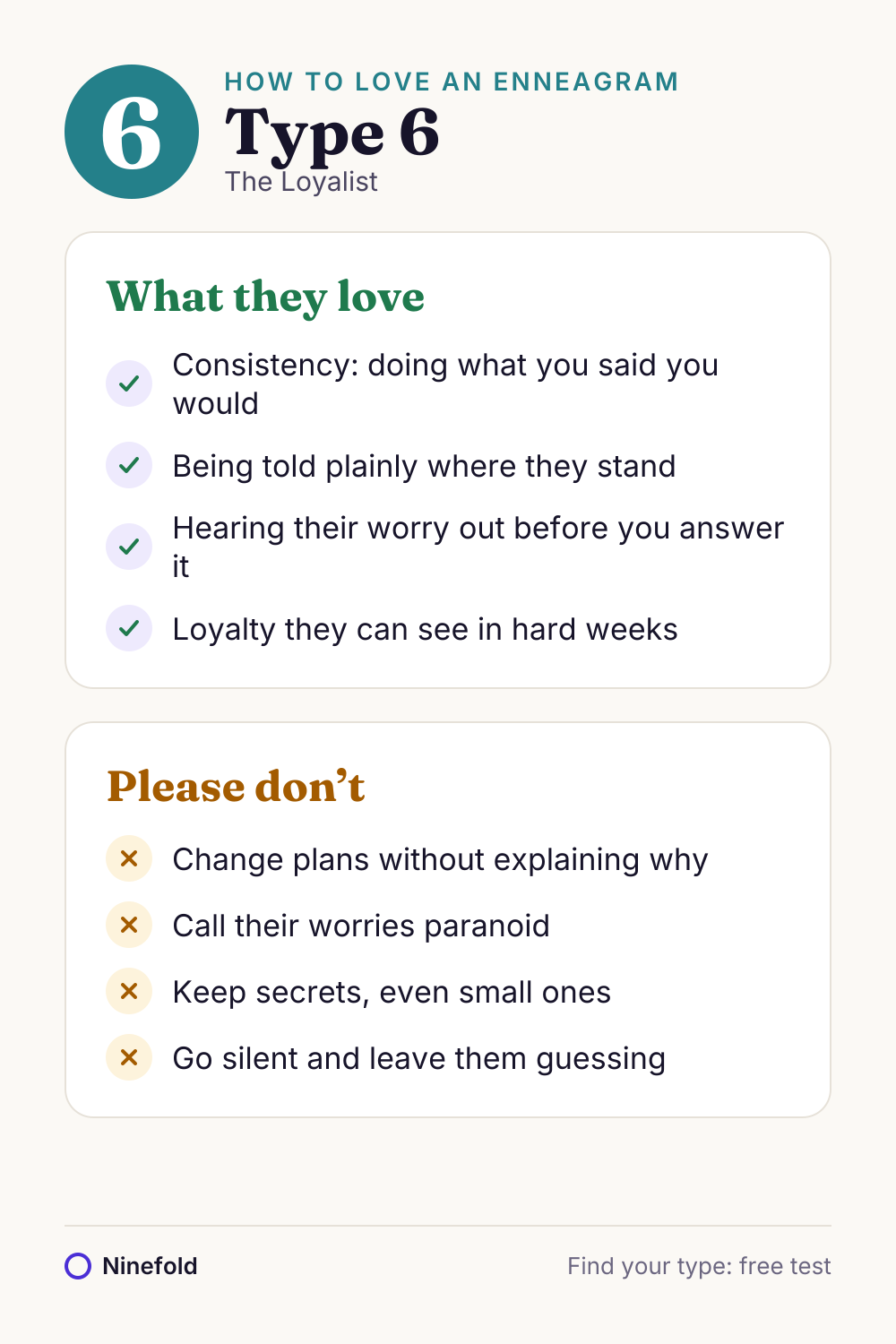
In relationships Sixes bring loyalty, humour and practical care: they remember the check-up, notice the car noise and show up in a crisis. Once committed, they put in the work to keep the relationship stable.
The common trap is testing a partner for proof of loyalty, through questions, suspicion or picking fights to see if the other person stays. Partners help by being consistent and direct about intentions, and Sixes help by saying the fear out loud as a fear, so it can be answered.
Type 6 and Type 1: The Reformer
Across the circleType 6 and Type 2: The Helper
Across the circleType 6 and Type 3: The Achiever
Connected by an arrowType 6 and Type 4: The Individualist
Across the circleType 6 and Type 5: The Investigator
Neighbours (wing)Type 6 and Type 6: The Loyalist
Same typeType 6 and Type 7: The Enthusiast
Neighbours (wing)Type 6 and Type 8: The Challenger
Across the circleType 6 and Type 9: The Peacemaker
Connected by an arrowSee how Type 6 pairs with each of the other eight on the Enneagram compatibility chart.
How Type 6 grows
- Write the worst case down, then the most likely case. Plan for the second one.
- Make one small decision a day without asking anyone, and notice that it holds.
- When suspicion rises, ask what evidence you would accept that the other person means well.
- Track the times your inner alarm was wrong as well as the times it was right.
- Use your body to settle your mind: a walk or slow breathing before a hard conversation shortens the "what if" loop.
A 7-day practice
What the Enneagram schools say about Type 6
The four main schools teach the same type with different emphasis. Where they disagree, this page follows the majority and names the exception.
| Topic | Where the schools agree | Where they differ |
|---|---|---|
| Name | Every school builds Type 6 around security, trust and doubt. | Riso and Hudson call it the Loyalist; Palmer and the Narrative tradition use the Loyal Skeptic or Devil’s Advocate; other teachers say the Guardian. |
| Passion and virtue | Fear as the passion and courage as the virtue, a pairing that goes back to Ichazo and runs through Naranjo, Palmer and Chestnut. | Some teachers say anxiety or doubt where Ichazo said fear. Riso and Hudson put more weight on the search for support and security as the driver. |
| Stress and growth | The lines run to Three and to Nine. | Riso and Hudson read them as stress toward Three and growth toward Nine. Palmer calls Nine the security point, where a Six goes when it feels safe. Chestnut teaches growth through the stress point as well: a Six grows by taking on the healthy action of Three, then the calm of Nine. |
| Subtypes | Three instinctual versions of the type exist: self-preservation, social and one-to-one. | Naranjo and Chestnut name each subtype and treat the one-to-one Six as the countertype, which overlaps with what Palmer and Riso and Hudson call the counterphobic Six. Riso and Hudson describe instinct stackings without the countertype idea. |
| Levels of development | Health changes how a type looks more than the type itself. | The nine-level scale is Riso and Hudson’s; other schools describe health in broader bands or not at all. |
- Riso, D. R., and Hudson, R. (1999). The Wisdom of the Enneagram. Bantam. ISBN 0553378201.
- Naranjo, C. (1994). Character and Neurosis. Gateways. ISBN 9780895560667.
- Palmer, H. (1988). The Enneagram. HarperSanFrancisco. ISBN 9780062506832.
- Chestnut, B. (2013). The Complete Enneagram. She Writes Press. ISBN 9781938314551.
Type 6 FAQ
What is an Enneagram type 6?
Type 6, often called the Loyalist, is the personality pattern built around security and trust. Sixes are committed, responsible and alert to risk, and their core fear is being left without support or guidance.
What is the difference between 6w5 and 6w7?
6w5 is more reserved, analytical and independent, and handles anxiety by understanding the problem. 6w7 is more sociable, playful and people-oriented, and handles anxiety by staying busy and connected.
Where does a type 6 go in stress and growth?
In stress a Six moves toward Three and becomes driven and image-conscious, trying to prove their worth through output. In growth a Six moves toward Nine and becomes calm, trusting and receptive.
What types are most often confused with type 6?
Types 1, 4 and 9. Ones also follow rules but out of principle, Fours are also reactive but searching for identity, and Nines are also loyal but go quiet inside where Sixes keep debating. The check on this page asks you to pick between their core motives.
How rare is Enneagram type 6?
No representative population study exists, so any percentage you see is a count of people who took one website’s test. Sixes often score as one of several types because they doubt their own answers, which skews those counts further. Treat rarity claims as marketing.
Are type 6s always anxious?
No. Fear is the core passion, and it shows as worry in some Sixes and as boldness in others. Counterphobic Sixes walk toward what scares them, so they can look fearless, and healthy Sixes hold doubt lightly enough to act through it.
What are the type 6 subtypes?
Self-preservation Sixes (warmth) seek safety through friendly alliances; social Sixes (duty) find it in rules and clear authority; one-to-one Sixes (strength and beauty) go against fear by becoming bold, and are the countertype. The check on this page shows which instinct leads for you.
What jobs should a type 6 avoid?
Roles with shifting ground and no explanation: chaotic startups that pivot often, jobs under an unpredictable boss, commission-only sales and solo high-stakes roles with nobody to test their thinking against. Sixes do their best work where the plan is stable and concerns are welcome.
Who is the best match for an Enneagram 6?
No type is a guaranteed match. Sixes do best with partners who are consistent, keep their word and say plainly where things stand. Nines, on Six’s growth line, often bring the calm that settles a Six’s mind.
Is there an MBTI type for Enneagram 6?
No fixed one. The MBTI sorts how you take in information and decide; the Enneagram sorts what motivates you. Sixes are often linked with ISFJ and ISTJ because those types also value duty and preparation, and a Six can still be any MBTI type.
Which famous people are Enneagram type 6?
Typing a public figure means guessing their private motives, so every list online is speculation. We do not publish one. The self-check on this page is a better guide to whether you are a Six than any celebrity comparison.