Type 7 in brief
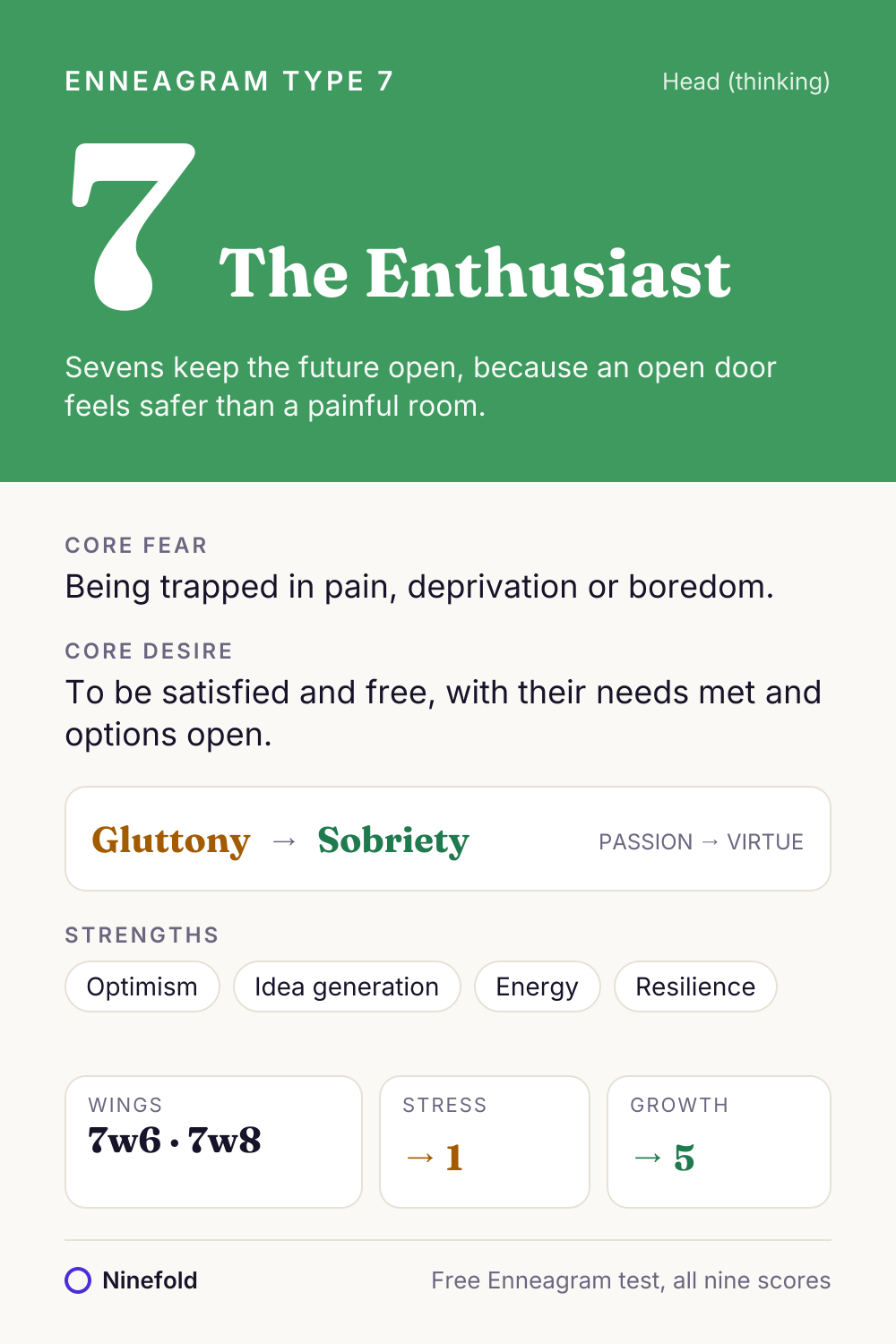
Type 7 sits in the head triad with 5 and 6, the three types organised around fear. A Five meets fear by withdrawing to study it and a Six by testing what can be trusted. A Seven moves away from it, toward stimulation, ideas and plans, so the anxiety underneath rarely gets a quiet moment to surface.
That motion gives Sevens their speed. They connect ideas from distant fields, reframe setbacks within minutes and make a group feel that something good is about to happen. The cost shows up when a project reaches the dull middle or a feeling turns heavy: the mind has already moved to the next option, and depth gets traded for range.
- Fixation
- Holy idea
- Defense mechanism
- Childhood pattern
Type 7 at a glance
Am I a Type 7? A 2-minute check
Ten statements from our full test: five that measure Type 7 and five from the types most often confused with it (3, 2). Rate each from 1 (not me) to 5 (very me).
I keep my options open in case something better comes along.
Not meVery meI set goals and keep track of my progress toward them.
Not meVery meI get bored quickly with routine.
Not meVery meI feel uneasy when I am not being productive.
Not meVery meI tend to turn bad experiences into something positive.
Not meVery meI can put my feelings aside to get the job done.
Not meVery meI have more plans and ideas than time to do them.
Not meVery meI find it easier to give help than to ask for it.
Not meVery meI avoid sitting with painful feelings for long.
Not meVery mePeople often come to me with their problems.
Not meVery me
Type 7 strengths and struggles
Strengths
- Optimism: they find the workable option in a setback within minutes.
- Idea generation: they connect fields and people that nobody else thought to combine.
- Energy: their enthusiasm gets a stalled group moving again.
- Resilience: bad news slows them down for a day and rarely for a month.
- Generosity: they share what they enjoy, from a restaurant tip to a business contact.
Struggles
- Finishing: the excitement fades in the middle and the next project looks better.
- Avoiding pain: changing the subject or making a joke when a conversation gets heavy.
- Overcommitting: saying yes to every good option and short-changing all of them.
- Impulsiveness: buying, booking or quitting before thinking through the cost.
- Rationalising: explaining away a broken promise so convincingly that they believe it themselves.
Signs you might be a Type 7
- You have more plans for next year than any one person could carry out.
- When something goes wrong, your first move is to find the upside or the next idea.
- Commitments feel easier when there is an exit somewhere in them.
- You get bored halfway through things you were excited to start.
- People describe you as fun, and you sometimes wonder whether they know you well.
- Being told you cannot do something makes you want it more.
- You talk your way out of sad conversations with a joke or a new topic.
- An empty weekend feels like a problem to solve.
Type 7 wings: 7w6 and 7w8
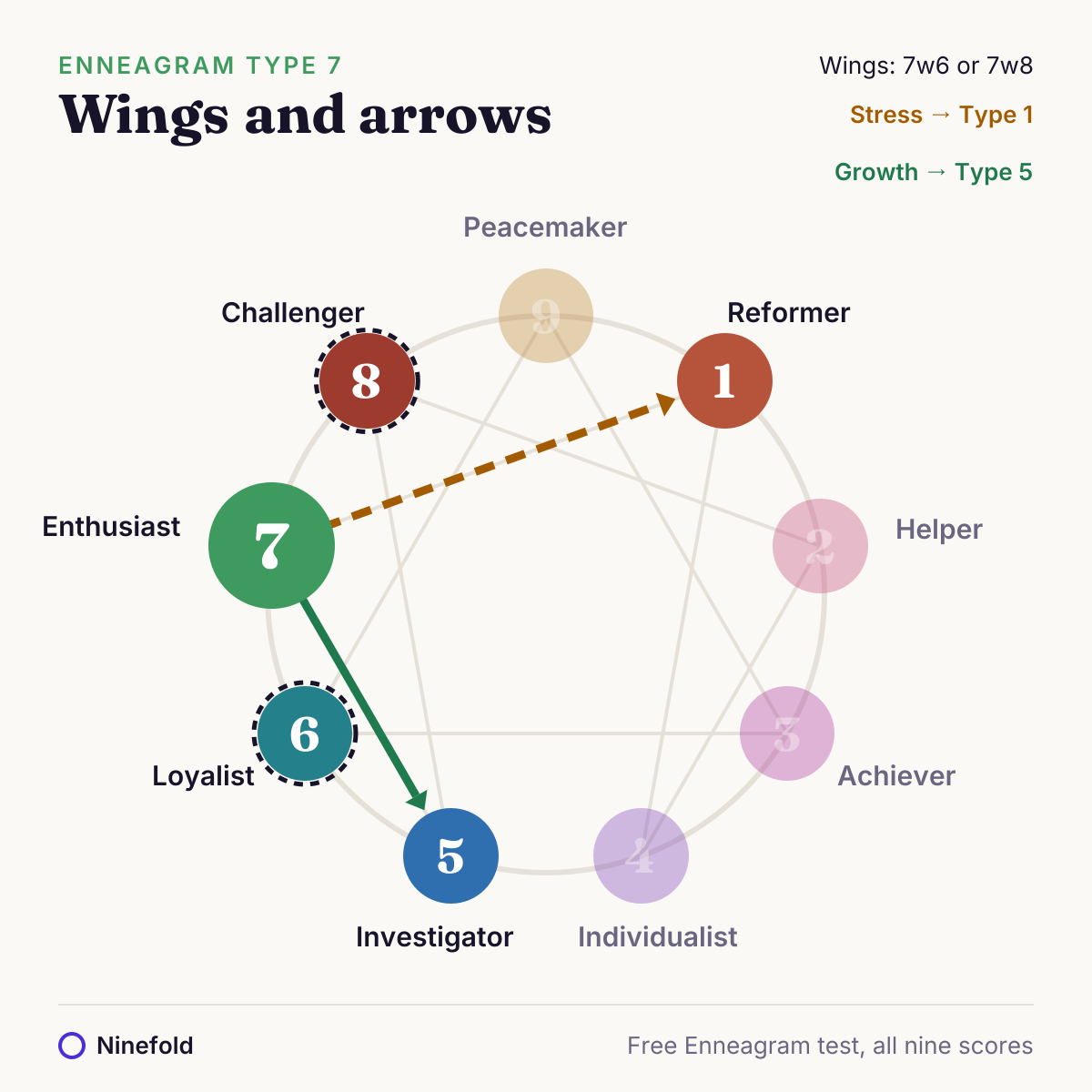
A wing is one of the two types next to yours on the circle. Most people lean toward one of them, and it colours how the core type shows up. Type 7’s neighbours are Type 6 and Type 8.
7w6, the Entertainer
The Six wing adds loyalty, humour and a need to stay connected to a group. 7w6s are playful, warm and responsive to people, and their enthusiasm often goes into shared plans and friendships. The risk is anxious busyness: saying yes to everyone and seeking reassurance through constant activity.
7w8, the Realist
The Eight wing adds force and a practical, materialistic edge. 7w8s are assertive, quick to act and good at turning appetite into business, deals and results. The risk is bulldozing: taking what they want fast and moving on before counting the cost to other people.
| 7w6 | 7w8 | |
|---|---|---|
| Core drive | Share good experiences with people they belong to | Get what they want and stay in control of it |
| Social energy | Playful, warm, eager to be liked | Bold, forceful, comfortable taking the lead |
| Handling anxiety | Stays busy with friends and seeks reassurance | Pushes harder and takes charge of the situation |
| At work | Creative, collaborative, good at rallying a team | Entrepreneurial, deal-driven, quick to act |
| In love | Affectionate and fun, worries about being left | Passionate and direct, resists being tied down |
| Under stress | Scatters, gets nervous and over-plans | Gets impatient, demanding and blunt |
| Growth edge | Stay with one commitment through the dull middle | Count the cost to others before taking what they want |
7w6 or 7w8? Pick the truer statement in each pair.
0 of 6 picked.
The three Type 7 subtypes
Each type comes in three versions, depending on which instinct leads: self-preservation (safety and resources), social (belonging and standing) or one-to-one (intensity with one person). The subtype often changes how the type looks more than the wing does.
Self-preservation Seven: keepers of the castle
Gluttony aimed at security. Self-preservation Sevens build a network of allies, family and opportunities that keeps them supplied and safe, and they are alert to every chance to get a good deal. They are practical, pleasure-loving and self-interested in a cheerful way, and they can look like Threes or Eights.
Social Seven: sacrifice
The countertype, the Seven that looks least like a Seven. Social Sevens go against gluttony by giving their energy to others and to causes, and they want to be seen as good for putting their own wants second. They are idealistic and helpful, which is why they often mistype as Twos.
One-to-one (sexual) Seven: suggestibility
Gluttony for an imagined, better world. One-to-one Sevens are dreamers who see people and plans through the optimism of someone in love, and they are quick to be swept up by an idea or a person. They are enthusiastic and light, and they can find ordinary life a letdown.
Which instinct leads? Rate each statement.
- Not meVery me
- Not meVery me
- Not meVery me
Move all three sliders to see your lead instinct.
Type 7 in stress and growth
Stress: toward Type 1
Under stress a Seven moves toward the average side of One: they become critical, rigid and impatient, lecturing others about doing things properly while their own plans fall apart.
Growth: toward Type 5
In growth a Seven takes on the healthy side of Five: focused, quiet and able to go deep into one subject. They stop needing new input to feel alive and discover that staying with one thing gives the satisfaction they were chasing across many.
What stress looks like
Type 7 → Type 1
- Gets critical and lectures others about doing it properly
- Becomes rigid about small rules while big plans slip
- Feels resentful that nobody else is pulling their weight
- Snaps at people with a sharp, perfectionist edge
What growth looks like
Type 7 → Type 5
- Goes deep into one subject for weeks at a time
- Enjoys quiet evenings with no plans
- Thinks a decision through before acting on it
- Finds enough in what is already here
Type 7 levels of development
The same type looks very different at its best and at its worst. The nine levels describe that range, from free and self-aware at level 1 to stuck and self-defeating at level 9. Stress, sleep and circumstance move people up and down the levels, so read them as a range you occupy.
- Level 1: Deeply grateful and present. Joy comes from what is here, and their energy goes into a few things done well.
- Level 2: Spontaneous, curious and resilient. Enjoys life openly and makes others feel the same.
- Level 3: Productive and versatile. Turns many interests into concrete results across several fields.
- Level 4: Starts to consume. Fills time with activities, purchases and plans so restlessness never catches up.
- Level 5: Scattered and hyperactive. Talks fast, jumps between projects and resists anything that limits options.
- Level 6: Excessive and self-centred. Demands more of everything, gets impatient with others and avoids responsibility.
- Level 7: Impulsive and escapist. Acts on whims to escape anxiety, often with reckless consequences.
- Level 8: Erratic and out of control, with manic swings and destructive habits used to outrun pain.
- Level 9: Panic and collapse when the escapes stop working. Professional help is needed at this level.
Type 7 or another type? The common mistypes
Type 7 vs Type 3
Both are energetic, optimistic and fast. A Three works toward a goal that earns admiration and will sacrifice fun for results. A Seven moves toward experiences that feel good and will drop a goal once it becomes tedious. If you push through boredom for the win, you lean Three; if you leave once the excitement goes, you lean Seven.
Type 7 vs Type 2
Both are warm, upbeat and social. A Two focuses on what others need and builds their worth on being helpful. A Seven focuses on what they want to experience and brings others along for the ride. Ask whether your generosity is aimed at being needed or at sharing a good time.
Check yourself in under a minute:
Type 7 at work: careers that fit and jobs to avoid
Sevens thrive where variety and new ideas pay: entrepreneurship, product, marketing, events, consulting, travel and any role that starts things. They are often the person who reframes a stalled project in a brainstorm and gets the room moving again.
They struggle with long repetitive stretches, heavy process and roles that only maintain. A manager gets the most from a Seven by giving them ownership of new work, pairing them with someone who finishes, and agreeing on a short list of priorities they can return to when a new idea pulls.
Founder or entrepreneur
Product manager or innovation lead
Marketing, brand or creative director
Events, travel or hospitality
Consultant
Journalist, presenter or podcaster
Jobs that tend to drain a Four
What a Four needs from a job
Type 7 in relationships: compatibility with every type
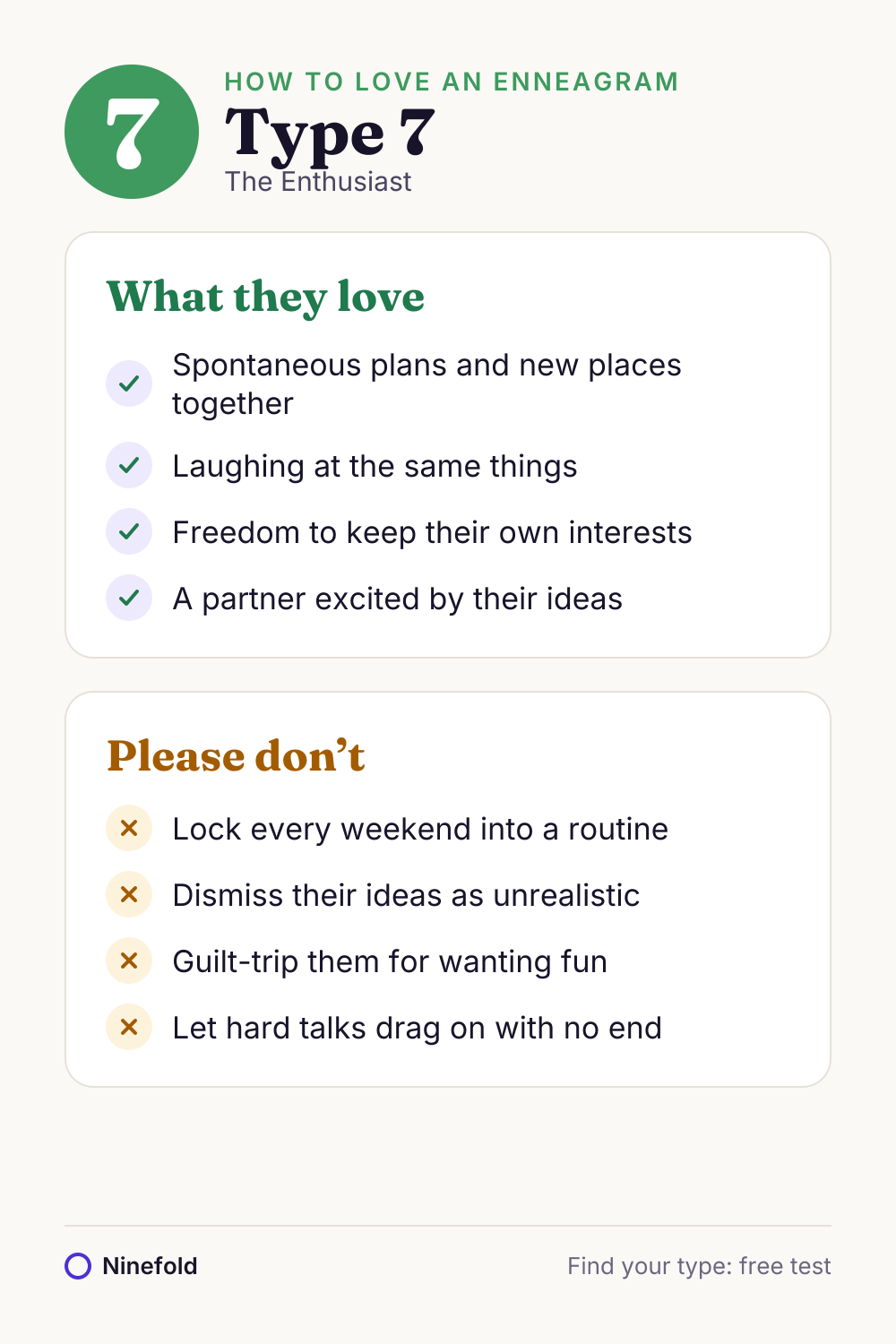
In relationships Sevens bring fun, generosity and a steady stream of plans. Partners get adventures, new places and someone who refuses to let life go stale.
The common trap is avoiding the hard parts: sadness, conflict and the ordinary weeks. A Seven can leave emotionally, through distraction, while still in the room. Partners help by naming problems plainly and staying with them, and Sevens help by sitting through one uncomfortable conversation to the end before proposing what to do next.
Type 7 and Type 1: The Reformer
Connected by an arrowType 7 and Type 2: The Helper
Across the circleType 7 and Type 3: The Achiever
Across the circleType 7 and Type 4: The Individualist
Across the circleType 7 and Type 5: The Investigator
Connected by an arrowType 7 and Type 6: The Loyalist
Neighbours (wing)Type 7 and Type 7: The Enthusiast
Same typeType 7 and Type 8: The Challenger
Neighbours (wing)Type 7 and Type 9: The Peacemaker
Across the circleSee how Type 7 pairs with each of the other eight on the Enneagram compatibility chart.
How Type 7 grows
- Finish one project before starting the next. Write the others on a list you can return to.
- When a painful feeling comes up, give it ten minutes before reaching for a plan or a distraction.
- Notice the moment you start planning ahead during a good experience, and come back to the one you are in.
- Practise saying no to good options so the great ones get your full attention.
- Spend one evening a week with no plans and see what shows up.
A 7-day practice
What the Enneagram schools say about Type 7
The four main schools teach the same type with different emphasis. Where they disagree, this page follows the majority and names the exception.
| Topic | Where the schools agree | Where they differ |
|---|---|---|
| Name | Every school builds Type 7 around freedom, possibility and avoiding pain. | Riso and Hudson call it the Enthusiast; Palmer and the Narrative tradition use the Epicure; other teachers say the Adventurer. |
| Passion and virtue | Gluttony as the passion and sobriety as the virtue, a pairing that goes back to Ichazo and runs through Naranjo, Palmer and Chestnut. | All of them read gluttony as an appetite for experiences and ideas, beyond food. Riso and Hudson put more weight on the desire to stay satisfied and free as the driver. |
| Stress and growth | The lines run to One and to Five. | Riso and Hudson read them as stress toward One and growth toward Five. Palmer calls Five the security point, where a Seven goes when it feels safe. Chestnut teaches growth through the stress point as well: a Seven grows by taking on the discipline of One, then the depth of Five. |
| Subtypes | Three instinctual versions of the type exist: self-preservation, social and one-to-one. | Naranjo and Chestnut give each subtype a name and a countertype (social Seven). Riso and Hudson describe instinct stackings without the countertype idea. |
| Levels of development | Health changes how a type looks more than the type itself. | The nine-level scale is Riso and Hudson’s; other schools describe health in broader bands or not at all. |
- Riso, D. R., and Hudson, R. (1999). The Wisdom of the Enneagram. Bantam. ISBN 0553378201.
- Naranjo, C. (1994). Character and Neurosis. Gateways. ISBN 9780895560667.
- Palmer, H. (1988). The Enneagram. HarperSanFrancisco. ISBN 9780062506832.
- Chestnut, B. (2013). The Complete Enneagram. She Writes Press. ISBN 9781938314551.
Type 7 FAQ
What is an Enneagram type 7?
Type 7, often called the Enthusiast, is the personality pattern built around freedom, variety and avoiding pain. Sevens are curious, optimistic and quick, and their core fear is being trapped in pain or deprivation.
What is the difference between 7w6 and 7w8?
7w6 is more playful, loyal and people-oriented, and puts their energy into friendships and shared plans. 7w8 is more assertive, practical and driven, and puts their energy into results and getting what they want.
Where does a type 7 go in stress and growth?
In stress a Seven moves toward One and becomes critical, rigid and impatient. In growth a Seven moves toward Five and becomes focused, quiet and able to go deep.
What types are most often confused with type 7?
Types 3 and 2. Threes are also energetic but stay with a goal for the recognition, and Twos are also warm and upbeat but organise around other people’s needs. The check on this page asks you to pick between their core motives.
How rare is Enneagram type 7?
No representative population study exists, so any percentage you see is a count of people who took one website’s test, and those samples depend on who chose to take it. Treat rarity claims as marketing.
What are the type 7 subtypes?
Self-preservation Sevens (keepers of the castle) build networks of allies and opportunities; social Sevens (sacrifice) put their own wants second for the group and are the countertype; one-to-one Sevens (suggestibility) are dreamers swept up by people and ideas. The check on this page shows which instinct leads for you.
What jobs should a type 7 avoid?
Roles with long repetitive stretches and nothing new: data entry, maintenance-only work, heavily regulated process jobs and long solo research with no variety. Sevens do their best work when they own something new.
Who is the best match for an Enneagram 7?
No type is a guaranteed match. Sevens do best with partners who enjoy adventure and still name problems plainly. Fives, on Seven’s growth line, often bring the depth and calm a Seven is missing.
What is the worst match for a type 7?
No pairing is doomed. Sevens report the most friction with partners who need fixed routines or who read their enthusiasm as irresponsibility, a pattern that can show up with Ones, on Seven’s stress line. Any pair works when both name what they need.
Is there an MBTI type for Enneagram 7?
No fixed one. The MBTI sorts how you take in information and decide; the Enneagram sorts what motivates you. Sevens are often linked with ENFP and ESFP because those types also chase possibility and experience, and a Seven can still be any MBTI type.
Which famous people are Enneagram type 7?
Typing a public figure means guessing their private motives, so every list online is speculation. We do not publish one. The self-check on this page is a better guide to whether you are a Seven than any celebrity comparison.