Type 5 in brief
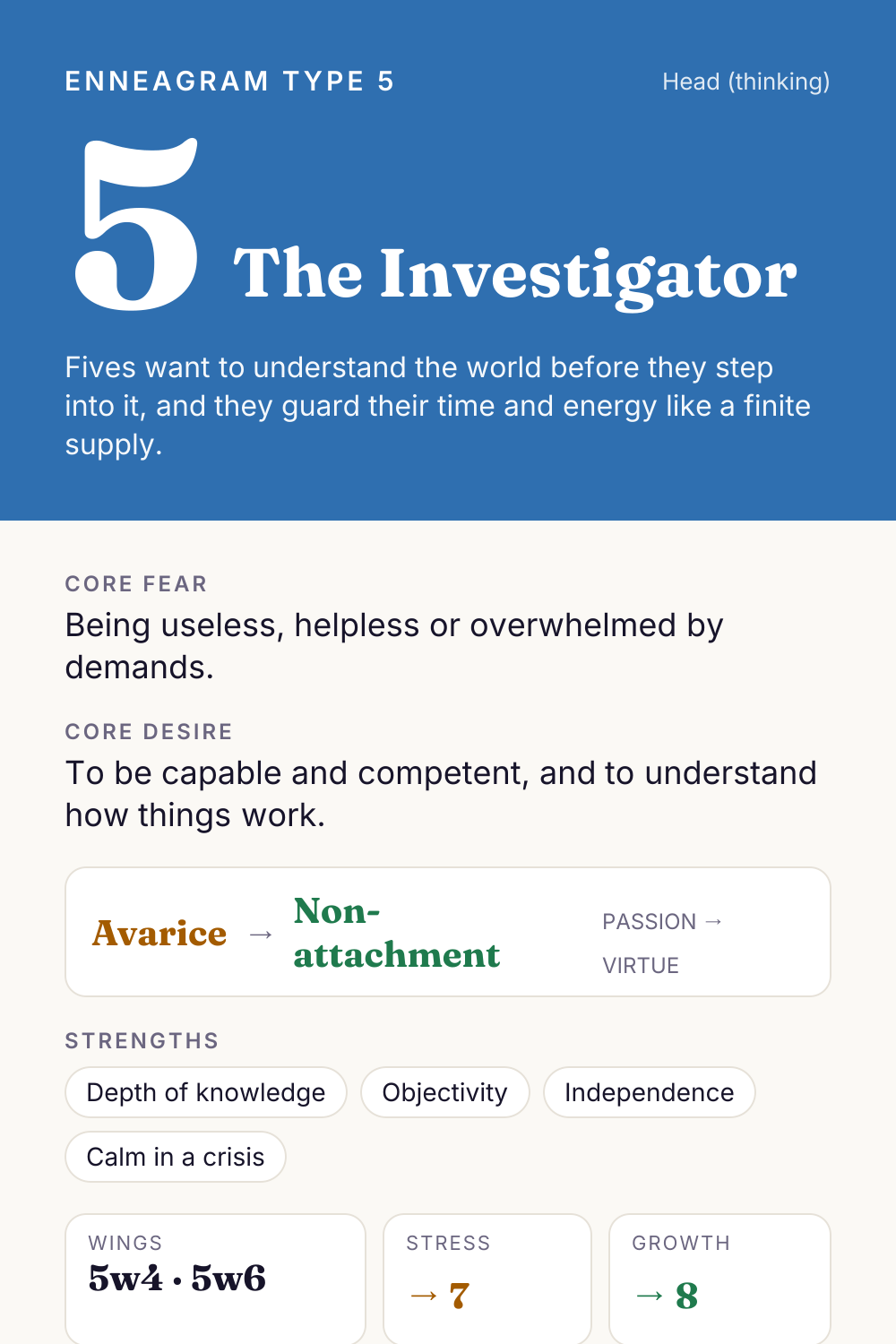
Type 5 sits in the head triad with 6 and 7, the three types whose core reaction is fear. A Six manages fear by seeking support and a Seven by seeking options. A Five manages it by retreating into the mind, studying a problem until they feel competent enough to face it.
That retreat makes Fives sharp, independent and calm in a crisis, because they have often thought it through in advance. They go deep into subjects most people skim and notice patterns others miss. The cost is a habit of minimising needs and contact: they treat energy as scarce, observe more than they take part, and can wait so long to feel ready that the chance to act passes.
- Fixation
- Holy idea
- Defense mechanism
- Childhood pattern
Type 5 at a glance
Am I a Type 5? A 2-minute check
Ten statements from our full test: five that measure Type 5 and five from the types most often confused with it (9, 4, 6). Rate each from 1 (not me) to 5 (very me).
I need plenty of time alone to recharge.
Not meVery meI go along with others to keep the peace.
Not meVery meI prefer to understand something fully before I act on it.
Not meVery meI avoid conflict, even when something bothers me.
Not meVery meI guard my time, energy and privacy carefully.
Not meVery meI am drawn to beauty, melancholy and things with emotional depth.
Not meVery meI watch a situation from a distance before I join in.
Not meVery meI long for things I do not have, or for times that are gone.
Not meVery meEmotional demands from other people can leave me drained.
Not meVery meI question authority, and I also want to be able to rely on it.
Not meVery me
Type 5 strengths and struggles
Strengths
- Depth of knowledge: they master subjects most people skim.
- Objectivity: they can look at a hard problem without panic or drama.
- Independence: they need little and rarely make demands.
- Calm in a crisis: they have often thought the scenario through in advance.
- Original thinking: they notice patterns and connections others miss.
Struggles
- Withdrawal: pulling away whenever contact feels like a demand.
- Over-preparing: waiting to know enough before acting, sometimes indefinitely.
- Rationing: time, feelings and presence get handed out sparingly.
- Detachment from body and emotion, which surface later and alone.
- Coming across as cold or aloof to people who want more contact.
Signs you might be a Type 5
- You need time alone to recharge, and you plan your week around protecting it.
- You would rather research a topic for hours than ask someone for a quick answer.
- Unexpected phone calls or visits feel like an intrusion on your time.
- You often know a great deal about a narrow subject that few people around you care about.
- You process feelings later, alone, after the event is over.
- You keep your needs small so that nobody can make demands of you in return.
- You watch a group for a while before deciding whether to join in.
- Being thought incompetent bothers you more than being thought cold.
Type 5 wings: 5w4 and 5w6
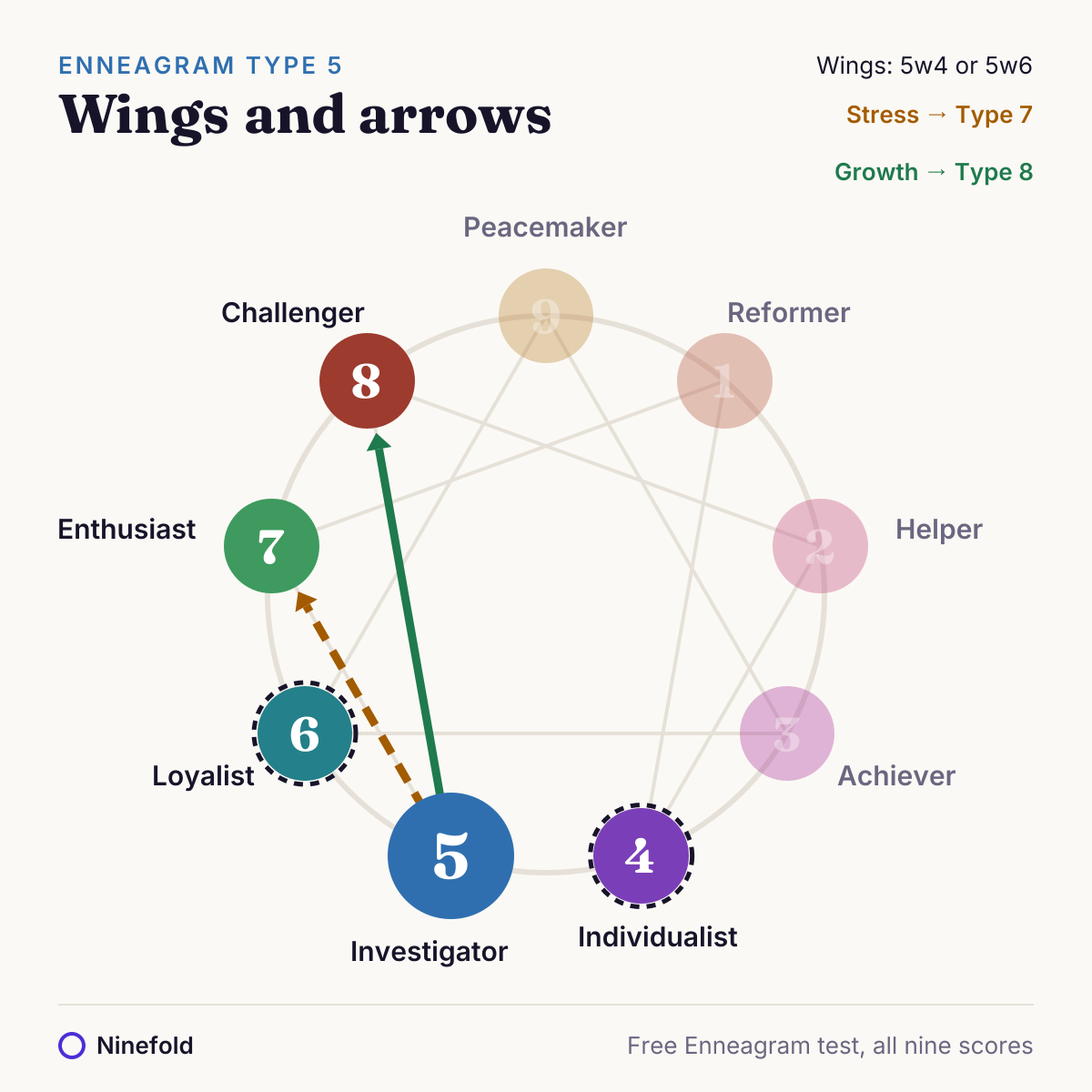
A wing is one of the two types next to yours on the circle. Most people lean toward one of them, and it colours how the core type shows up. Type 5’s neighbours are Type 4 and Type 6.
5w4, the Iconoclast
The Four wing adds imagination and emotional depth. 5w4s are more creative and unconventional, drawn to art, philosophy and ideas that break with the mainstream, and they care about originality as much as accuracy. The risk is a double withdrawal, into both thought and mood, which can make them hard to reach.
5w6, the Problem Solver
The Six wing adds structure, caution and loyalty. 5w6s are more systematic and practical, drawn to technical fields and to fixing problems with a clear method, and they value a small circle of trusted people. The risk is anxious overpreparation, with every scenario mapped before they will commit to any of them.
| 5w4 | 5w6 | |
|---|---|---|
| Core drive | Understand the world in an original way | Understand the world well enough to be safe in it |
| Social energy | Solitary, private, follows their own path | Small trusted circle, more cooperative |
| Creative style | Imaginative, artistic, unconventional | Systematic, technical, built to work |
| At work | Philosophy, art, theory, independent research | Engineering, science, data, troubleshooting |
| In love | Intense in private, romantic in their own way | Loyal and steady, shows care through reliability |
| Under stress | Withdraws into mood and fantasy | Grows anxious and overprepares |
| Growth edge | Bring ideas into the world and share them | Commit before every risk is mapped |
5w4 or 5w6? Pick the truer statement in each pair.
0 of 6 picked.
The three Type 5 subtypes
Each type comes in three versions, depending on which instinct leads: self-preservation (safety and resources), social (belonging and standing) or one-to-one (intensity with one person). The subtype often changes how the type looks more than the wing does.
Self-preservation Five: castle
The most private Five. Self-preservation Fives build a protected space, a home or a routine, and keep their needs small so they depend on others as little as possible. They are the least expressive of the three subtypes and guard their boundaries closely.
Social Five: totem
The Five who connects through knowledge. Social Fives relate to people through shared ideals and expertise, and they look up to experts and to systems that explain the big questions. They search for ultimate meaning and can seem more engaged in groups than other Fives, as long as the talk is about ideas.
One-to-one (sexual) Five: confidence
The countertype, the Five with the most visible feelings. One-to-one Fives look for one partner they can trust completely, and they have a romantic streak and a vivid inner life, often expressed through art. They are more emotionally sensitive than other Fives, which is why they can mistype as Four.
Which instinct leads? Rate each statement.
- Not meVery me
- Not meVery me
- Not meVery me
Move all three sliders to see your lead instinct.
Type 5 in stress and growth
Stress: toward Type 7
Under stress a Five moves toward the average side of Seven. The focus scatters: they jump between ideas and distractions, take on too many interests at once and look for stimulation to escape the pressure, which leaves them more drained.
Growth: toward Type 8
In growth a Five takes on the healthy side of Eight: grounded, decisive and willing to act on what they know. They trust their body and instincts along with their mind, and their expertise starts to shape the world around them.
What stress looks like
Type 5 → Type 7
- Scatters attention across ideas and distractions
- Takes on too many interests at once
- Looks for stimulation to escape pressure
- Grows restless and impatient with the task at hand
What growth looks like
Type 5 → Type 8
- Acts on what they know before feeling fully ready
- States a view plainly and stands behind it
- Takes up space, in a room and in their body
- Uses expertise to lead or protect others
Type 5 levels of development
The same type looks very different at its best and at its worst. The nine levels describe that range, from free and self-aware at level 1 to stuck and self-defeating at level 9. Stress, sleep and circumstance move people up and down the levels, so read them as a range you occupy.
- Level 1: Clear-sighted and engaged. Knowledge becomes insight they act on, and they trust that they have enough to step fully into the world.
- Level 2: Perceptive and curious, able to see things freshly and to stay with a hard question until it opens up.
- Level 3: Original and expert. They master a field and contribute ideas that change how others see a problem.
- Level 4: Starts to prepare without end. Collects information and skills, and waits to feel competent enough to begin.
- Level 5: Detached and preoccupied. Lives in their head, guards time and privacy closely, and engages less with people.
- Level 6: Provocative and cynical. Uses intellect to keep people away and scorns views they consider naive.
- Level 7: Isolated and eccentric, cutting off contact and rejecting the help or attachment that could steady them.
- Level 8: Haunted by their own thoughts, unable to switch off, with fears that start to distort what they perceive.
- Level 9: Complete withdrawal, with a risk of psychotic breaks or self-destructive behaviour. Professional help is needed at this level.
Type 5 or another type? The common mistypes
Type 5 vs Type 9
Both are quiet, low-key and withdraw from conflict. A Nine withdraws to keep inner calm and tends to go along with others. A Five withdraws to protect energy and keeps a firm private boundary, with a mind that stays busy. If you tune out to stay comfortable, you lean Nine; if you pull back to think, you lean Five.
Type 5 vs Type 4
Both are introverted, private and drawn to depth. A Five withdraws to observe and understand, and feelings are processed later. A Four withdraws to feel and to explore identity, and the thinking serves the feeling. If you are protecting your energy, you lean Five; if you are protecting your identity, you lean Four.
Type 5 vs Type 6
Both are thinkers who prepare for problems, and the 5w6 sits right on the border. A Six looks outward for reliable people and authorities to lean on and asks for reassurance. A Five looks inward and relies on their own understanding, keeping their distance from groups. Ask whether you solve worry by checking with others or by studying alone.
Check yourself in under a minute:
Type 5 at work: careers that fit and jobs to avoid
Fives do their best work where depth and independence are valued: research, engineering, software, data, analysis, academia, archival work and any specialist role with long stretches of focused time. They are often the person a team asks when nobody else knows the answer.
They struggle with constant meetings, open-plan noise and roles built on networking or quick small talk. A manager gets more from a Five by sending context before meetings, protecting blocks of focus time, and giving autonomy over method, because a Five who feels micromanaged will quietly withdraw their effort.
Researcher or academic
Software engineer or data scientist
Analyst (financial, intelligence, policy)
Archivist, librarian or historian
Technical specialist or consultant
Nonfiction or technical writer
Jobs that tend to drain a Four
What a Four needs from a job
Type 5 in relationships: compatibility with every type
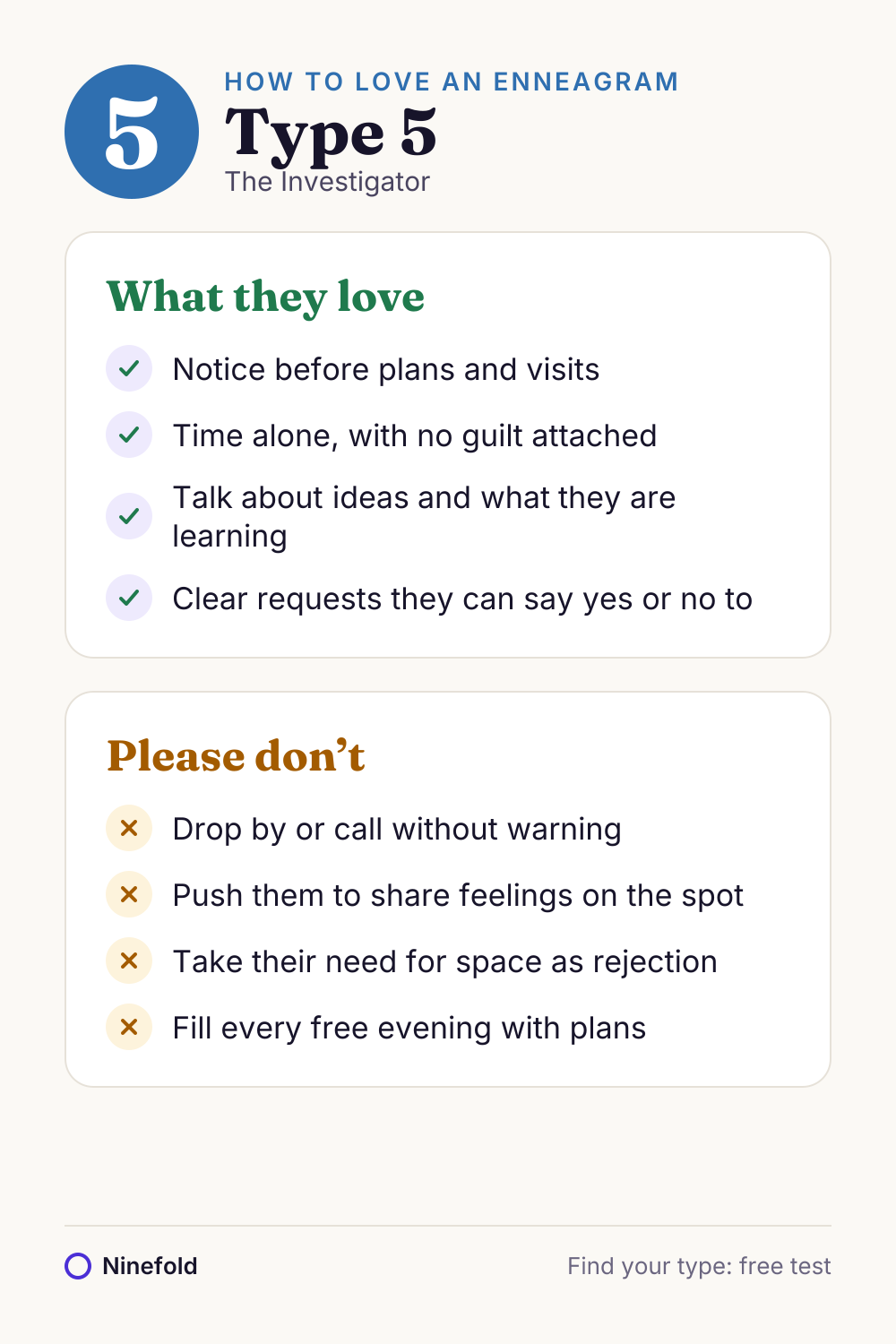
In relationships Fives are loyal, low-drama and respectful of a partner’s independence. They show care through attention to what interests the other person, through sharing knowledge and by being steady when things go wrong.
The common trap is withholding: time, feelings and presence get rationed, and a partner can feel shut out. Partners help by giving notice, space and clear requests in place of vague emotional demands, and Fives help by sharing what they feel before they have fully analysed it.
Type 5 and Type 1: The Reformer
Across the circleType 5 and Type 2: The Helper
Across the circleType 5 and Type 3: The Achiever
Across the circleType 5 and Type 4: The Individualist
Neighbours (wing)Type 5 and Type 5: The Investigator
Same typeType 5 and Type 6: The Loyalist
Neighbours (wing)Type 5 and Type 7: The Enthusiast
Connected by an arrowType 5 and Type 8: The Challenger
Connected by an arrowType 5 and Type 9: The Peacemaker
Across the circleSee how Type 5 pairs with each of the other eight on the Enneagram compatibility chart.
How Type 5 grows
- Start before you feel ready. Pick a small project and act on what you know today.
- Notice when you hold back time or energy, and test giving a little more than feels comfortable.
- Move your body every day. Exercise brings you out of your head and back into the room.
- Tell one person a feeling while it is still happening, even if it comes out rough.
- Ask for help on something you could figure out alone, and notice what the contact gives you.
A 7-day practice
What the Enneagram schools say about Type 5
The four main schools teach the same type with different emphasis. Where they disagree, this page follows the majority and names the exception.
| Topic | Where the schools agree | Where they differ |
|---|---|---|
| Name | Every school builds Type 5 around knowledge, privacy and conserving energy. | Riso and Hudson call it the Investigator; Palmer and the Narrative tradition use the Observer; other teachers say the Thinker. |
| Passion and virtue | Avarice as the passion and non-attachment as the virtue, a pairing that goes back to Ichazo and runs through Naranjo, Palmer and Chestnut. | Riso and Hudson put more weight on the self-image of being perceptive and competent than on avarice as the driver. |
| Stress and growth | The lines run to Seven and to Eight. | Riso and Hudson read them as stress toward Seven and growth toward Eight. Palmer calls Eight the security point, where a Five goes when it feels safe. Chestnut teaches growth through the stress point: a Five grows by moving ahead to the healthy side of Seven to open up to people and experience, and back to Eight to reclaim strength and action. |
| Subtypes | Three instinctual versions of the type exist: self-preservation, social and one-to-one. | Naranjo and Chestnut give each subtype a name and a countertype (one-to-one Five). Riso and Hudson describe instinct stackings without the countertype idea. |
| Levels of development | Health changes how a type looks more than the type itself. | The nine-level scale is Riso and Hudson’s; other schools describe health in broader bands or not at all. |
- Riso, D. R., and Hudson, R. (1999). The Wisdom of the Enneagram. Bantam. ISBN 0553378201.
- Naranjo, C. (1994). Character and Neurosis. Gateways. ISBN 9780895560667.
- Palmer, H. (1988). The Enneagram. HarperSanFrancisco. ISBN 9780062506832.
- Chestnut, B. (2013). The Complete Enneagram. She Writes Press. ISBN 9781938314551.
Type 5 FAQ
What is an Enneagram type 5?
Type 5, often called the Investigator, is the personality pattern built around understanding the world and conserving energy. Fives are curious, independent and analytical, and their core fear is being useless, helpless or overwhelmed.
What is the difference between 5w4 and 5w6?
5w4 is more creative, emotional and unconventional, drawn to art and big ideas. 5w6 is more systematic, cautious and practical, drawn to technical problems and a small circle of trusted people.
Where does a type 5 go in stress and growth?
In stress a Five moves toward Seven and becomes scattered, distractible and restless. In growth a Five moves toward Eight and becomes grounded, decisive and confident enough to act on what they know.
What types are most often confused with type 5?
Types 9, 4 and 6. Nines also withdraw, but to keep the peace, Fours also turn inward, though to feel and explore identity, and Sixes also prepare for problems while looking to others for support. The check on this page asks you to pick between their core motives.
How rare is Enneagram type 5?
No representative population study exists, so any percentage you see is a count of people who took one website’s test. Fives are drawn to systems and self-analysis, which may bring more of them to online tests than the general population would. Treat rarity claims as marketing.
What are the type 5 subtypes?
Self-preservation Fives (castle) guard a private space and keep their needs small; social Fives (totem) connect through shared knowledge and ideals; one-to-one Fives (confidence) look for one partner they can trust completely and are the countertype, the Five with the most visible feelings. The check on this page shows which instinct leads for you.
Who are Enneagram 5s most compatible with?
No type is a guaranteed match. Fives do best with partners who respect their need for space, give notice before plans and enjoy talking about ideas. The pairs on this page show how a Five works with each of the nine types.
What jobs should a type 5 avoid?
Roles that drain energy through constant contact: open-plan jobs with nonstop interruption, networking-heavy sales, back-to-back meetings, and micromanaged positions. Fives do their best work with long blocks of focus and control over method.
Do Enneagram 5s get jealous?
They can, and it often stays hidden. A Five invests in few close bonds, so a threat to one can hit hard, and they tend to process the feeling alone before saying anything. Naming it early, even roughly, keeps it from turning into withdrawal.
Is there an MBTI type for Enneagram 5?
No fixed one. The MBTI sorts how you take in information and decide; the Enneagram sorts what motivates you. Fives are often linked with INTP and INTJ because those types also centre on analysis and independence, and a Five can still be any MBTI type.
Which famous people are Enneagram type 5?
Typing a public figure means guessing their private motives, so every list online is speculation. We do not publish one. The self-check on this page is a better guide to whether you are a Five than any celebrity comparison.