Type 1 in brief
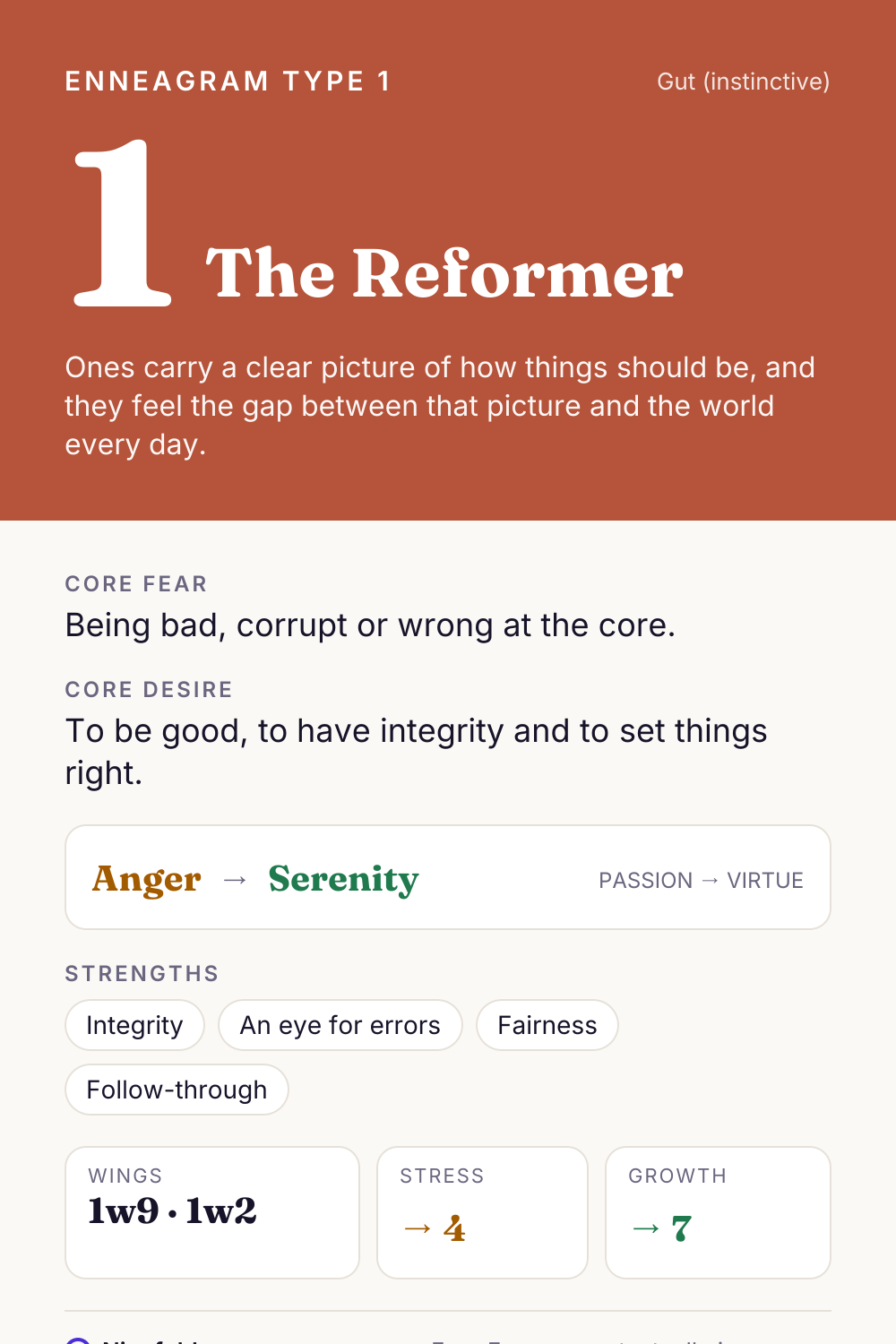
Type 1 sits in the gut triad with 8 and 9, the three types whose core reaction is anger. An Eight lets the anger out and a Nine falls asleep to it. A One keeps it under control and turns it into standards, so it comes out as correction, tension in the jaw and a running commentary on how things could be done better.
That inner critic is what gives Ones their strengths. They hold themselves to rules before they ask anyone else to follow them, they notice errors early, and they will do the tedious part of a job properly because skipping it would bother them for days. The cost is that the critic seldom rests, and the same voice that improves the work makes it hard for a One to enjoy anything that is still unfinished.
- Fixation
- Holy idea
- Defense mechanism
- Childhood pattern
Type 1 at a glance
Am I a Type 1? A 2-minute check
Ten statements from our full test: five that measure Type 1 and five from the types most often confused with it (6, 3). Rate each from 1 (not me) to 5 (very me).
I notice what is wrong or could be done better almost everywhere I look.
Not meVery meI think through what could go wrong before I commit.
Not meVery meI hold myself to standards other people find unnecessarily high.
Not meVery meI question authority, and I also want to be able to rely on it.
Not meVery meWhen I cut a corner, it nags at me long after.
Not meVery meI stay loyal to the groups and people I have chosen.
Not meVery meI feel a quiet anger when people ignore the rules that keep things fair.
Not meVery meI adjust how I come across depending on who I am with.
Not meVery meI find it hard to relax until a task is done properly.
Not meVery meBeing seen as successful matters to me more than I usually admit.
Not meVery me
Type 1 strengths and struggles
Strengths
- Integrity: they do what they said they would, including the parts nobody will check.
- An eye for errors: they spot the flaw in a contract, a process or an argument early, while it is still cheap to fix.
- Fairness: they apply the same rules to themselves and to the people they like, which makes them trusted referees.
- Follow-through: a standard, once agreed, still gets kept a year later.
- Purpose: frustration with how things are turns into concrete work to improve them.
Struggles
- The inner critic: a voice that grades every action and seldom says "well done".
- Held-back anger: irritation stays under the surface until it leaks out as tight replies, sighs or corrections.
- Black-and-white thinking: there is one right way, and every other way reads as a mistake.
- Trouble resting: pleasure feels earned only after the list is done, and the list keeps growing.
- Correcting the people they love: the eye that improves the work starts grading a partner or a child.
Signs you might be a Type 1
- You see the typo, the crooked frame or the skipped step before anyone else in the room does.
- There is a voice in your head that comments on what you should have done, and it rarely takes a day off.
- You get irritated when people break rules that you follow at a cost to yourself.
- You have trouble relaxing until the list is done, and the list is never done.
- People describe you as calm or controlled, while inside you are holding back frustration.
- You redo other people’s work quietly because doing it right matters more to you than the time it costs.
- Being called careless or unfair stings more than being called boring.
- You feel responsible for fixing problems that nobody asked you to fix.
Type 1 wings: 1w9 and 1w2
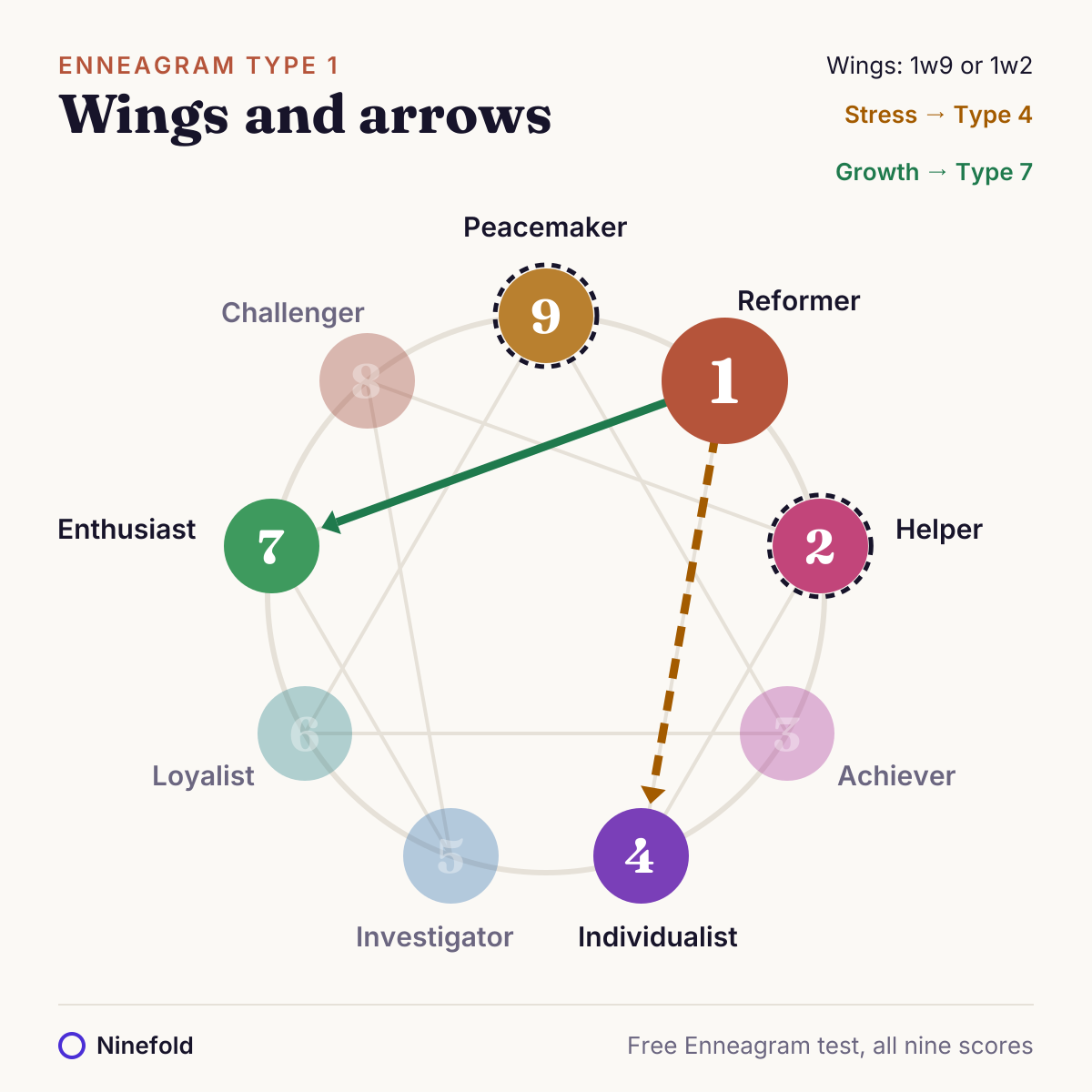
A wing is one of the two types next to yours on the circle. Most people lean toward one of them, and it colours how the core type shows up. Type 1’s neighbours are Type 9 and Type 2.
1w9, the Idealist
The Nine wing adds calm and distance. 1w9s are cooler, more reserved and more abstract in their ideals, and they often prefer to fix a system from a quiet corner over arguing for it in public. The risk is detachment: they can hold impossible standards in silence and resent people for not reading them.
1w2, the Advocate
The Two wing adds warmth and a pull toward people. 1w2s want to improve the world for someone, so they teach, campaign and mentor, and they say out loud what should change. The risk is that helping turns into instructing, and a 1w2 can feel that people who ignore their advice are being both wrong and ungrateful.
| 1w9 | 1w2 | |
|---|---|---|
| Core drive | Live up to an ideal, calmly and on their own | Improve things for people, and say so |
| Social energy | Reserved, cool, prefers a small circle | Warm, outspoken, comfortable leading a group |
| Creative style | Precise and minimal, refined until nothing is out of place | Purposeful, made to teach or persuade |
| At work | Systems, editing, quality: fixes the process from a quiet desk | Teaching, advocacy, management: fixes the process by moving people |
| In love | Steady and private, shows care by keeping order | Devoted and helpful, can slip into advising a partner |
| Under stress | Withdraws, goes rigid and resents in silence | Lectures, criticises and feels unappreciated |
| Growth edge | Say the frustration out loud while it is still small | Ask before helping, and let people choose their own way |
1w9 or 1w2? Pick the truer statement in each pair.
0 of 6 picked.
The three Type 1 subtypes
Each type comes in three versions, depending on which instinct leads: self-preservation (safety and resources), social (belonging and standing) or one-to-one (intensity with one person). The subtype often changes how the type looks more than the wing does.
Self-preservation One: worry
The most perfectionistic One. Self-preservation Ones turn anger into anxious effort: they worry about getting things right, plan for what could fail and keep working on themselves. The anger stays out of sight, often under a warm and friendly manner, which is why they can look like a Six.
Social One: non-adaptability
Social Ones see themselves as an example of the right way to do things, and they hold to it in groups. They are cooler and more intellectual than the other Ones, focused on correct procedure and on being the person who knows it. Their anger shows as calm, controlled certainty.
One-to-one (sexual) One: zeal
The countertype, the One whose anger shows. One-to-one Ones focus on reforming other people, especially those close to them, and feel entitled to push for change. They are more impulsive and openly angry than the other Ones, which is why they can mistype as Eight.
Which instinct leads? Rate each statement.
- Not meVery me
- Not meVery me
- Not meVery me
Move all three sliders to see your lead instinct.
Type 1 in stress and growth
Stress: toward Type 4
Under stress a One moves toward the average side of Four. The control slips and they turn moody, feel misunderstood and slide into self-pity, sometimes alongside a quiet urge to drop the rules they have been carrying and escape them for a while.
Growth: toward Type 7
In growth a One takes on the healthy side of Seven: lighter, curious and able to enjoy something without first earning it. Play stops feeling like a reward for finished work, and that ease tends to make their judgement more generous too.
What stress looks like
Type 1 → Type 4
- Feels misunderstood, as if nobody sees how much effort goes in
- Turns moody and withdraws into self-pity
- Longs to drop the rules and escape somewhere else
- Envies people who seem freer and less burdened
What growth looks like
Type 1 → Type 7
- Does something for fun before the work is finished
- Laughs at a mistake and moves on
- Tries a new way of doing things out of curiosity
- Sees several right answers where there used to be one
Type 1 levels of development
The same type looks very different at its best and at its worst. The nine levels describe that range, from free and self-aware at level 1 to stuck and self-defeating at level 9. Stress, sleep and circumstance move people up and down the levels, so read them as a range you occupy.
- Level 1: At peace with imperfection. Their sense of right becomes practical wisdom, and they can act firmly without needing to be the one who is right.
- Level 2: Fair, conscientious and reasonable, with ethics they apply to themself first.
- Level 3: Principled and responsible. They improve the places they work in by example, and people trust their word.
- Level 4: Starts to feel that everything depends on them getting it right. Earnest, orderly and quick to explain the correct way.
- Level 5: Tightly self-controlled and detail-bound. Method becomes rigid, and other people’s shortcuts feel like a personal offence.
- Level 6: Openly critical and moralising. Resentment comes out as lectures and corrections while their own impulses get pushed down harder.
- Level 7: Rigid and self-righteous, sure that they alone see clearly, and able to justify harshness toward anyone who disagrees.
- Level 8: Fixated on other people’s faults while secretly doing what they condemn, which feeds a growing self-loathing.
- Level 9: Punishing toward themself and others, with a risk of breakdown or self-harm. Professional help is needed at this level.
Type 1 or another type? The common mistypes
Type 1 vs Type 6
Both are dutiful, rule-aware and hard on themselves. A One follows rules because they believe in what is right, and their reference point is an inner standard. A Six follows rules because they offer security, and the reference point is an outside authority or group they trust. If you would break a bad rule on principle, you lean One; if you check with people you trust first, you lean Six.
Type 1 vs Type 3
Both are efficient, goal-driven and polished at work. A One cares about whether the work is correct and would rather miss a deadline than ship something wrong. A Three cares about whether the work succeeds and will adapt the method to win. Ask yourself which hurts more: being wrong in private, or failing in public.
Check yourself in under a minute:
Type 1 at work: careers that fit and jobs to avoid
Ones do their best work where accuracy and fairness matter: law, compliance, editing, engineering, medicine, quality control, teaching, and any role that sets or protects a standard. They are often the person who writes the process document and the one who still follows it a year later.
They struggle in places that reward speed over correctness or tolerate sloppy shortcuts. A manager gets more from a One by agreeing on what "done" means at the start and by acknowledging the care in their work, because any criticism from outside adds to the criticism they have already given themselves.
Editor, proofreader or technical writer
Lawyer, judge or compliance officer
Quality assurance or safety engineer
Teacher or trainer
Surgeon, pharmacist or lab scientist
Nonprofit or policy work
Jobs that tend to drain a Four
What a Four needs from a job
Type 1 in relationships: compatibility with every type
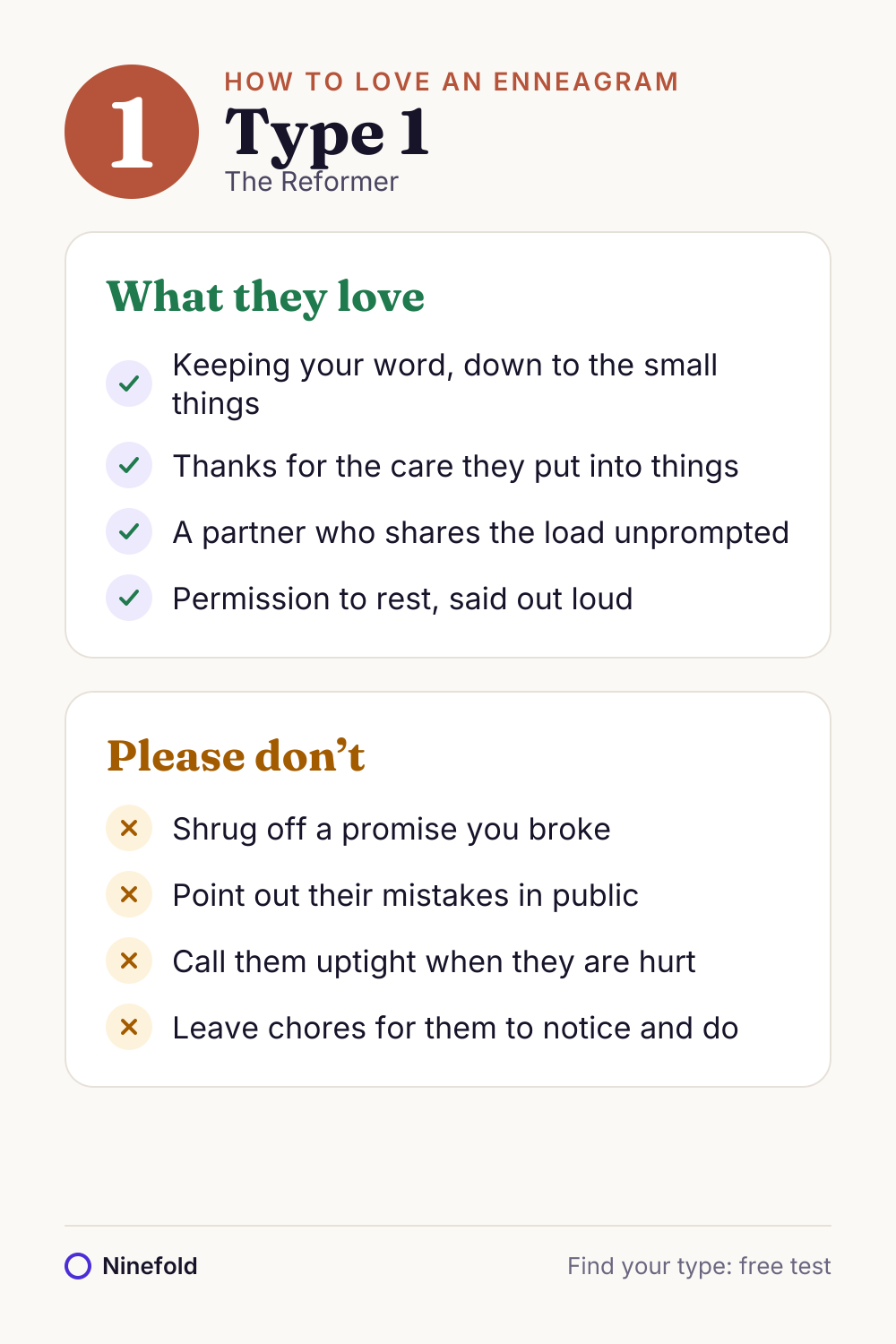
In relationships Ones are loyal, dependable and serious about commitments. They show love by keeping promises, improving the shared home and turning up on time, and they expect the same care in return.
The common trap is correction: the same eye that keeps standards high at work starts grading a partner’s habits. Partners help by naming the anger under the calm and inviting it into the open, and Ones help by letting some things stay imperfect and asking for what they need before resentment builds.
Type 1 and Type 1: The Reformer
Same typeType 1 and Type 2: The Helper
Neighbours (wing)Type 1 and Type 3: The Achiever
Across the circleType 1 and Type 4: The Individualist
Connected by an arrowType 1 and Type 5: The Investigator
Across the circleType 1 and Type 6: The Loyalist
Across the circleType 1 and Type 7: The Enthusiast
Connected by an arrowType 1 and Type 8: The Challenger
Same triadType 1 and Type 9: The Peacemaker
Neighbours (wing)See how Type 1 pairs with each of the other eight on the Enneagram compatibility chart.
How Type 1 grows
- When the inner critic speaks, ask whose standard it is quoting and whether you would apply it to a friend.
- Schedule time for pleasure that has no purpose, and protect it the way you protect work.
- Notice anger in your body (jaw, shoulders, breath) and say it out loud while it is still small.
- Pick one area where "good enough" is the right standard and practise stopping there.
- Ask people how they would do something before you show them the correct way.
A 7-day practice
What the Enneagram schools say about Type 1
The four main schools teach the same type with different emphasis. Where they disagree, this page follows the majority and names the exception.
| Topic | Where the schools agree | Where they differ |
|---|---|---|
| Name | Every school builds Type 1 around goodness, correctness and the drive to improve. | Riso and Hudson call it the Reformer; Palmer and the Narrative tradition use the Perfectionist; other teachers say the Idealist. |
| Passion and virtue | Anger as the passion and serenity as the virtue, a pairing that goes back to Ichazo and runs through Naranjo, Palmer and Chestnut. | Riso and Hudson put more weight on the self-image of being right and reasonable than on anger as the driver. |
| Stress and growth | The lines run to Four and to Seven. | Riso and Hudson read them as stress toward Four and growth toward Seven. Palmer calls Seven the security point, where a One goes when it feels safe. Chestnut teaches growth through the stress point: a One grows by moving ahead to the healthy side of Four to own feelings, and back to Seven to reclaim play. |
| Subtypes | Three instinctual versions of the type exist: self-preservation, social and one-to-one. | Naranjo and Chestnut give each subtype a name and a countertype (one-to-one One). Riso and Hudson describe instinct stackings without the countertype idea. |
| Levels of development | Health changes how a type looks more than the type itself. | The nine-level scale is Riso and Hudson’s; other schools describe health in broader bands or not at all. |
- Riso, D. R., and Hudson, R. (1999). The Wisdom of the Enneagram. Bantam. ISBN 0553378201.
- Naranjo, C. (1994). Character and Neurosis. Gateways. ISBN 9780895560667.
- Palmer, H. (1988). The Enneagram. HarperSanFrancisco. ISBN 9780062506832.
- Chestnut, B. (2013). The Complete Enneagram. She Writes Press. ISBN 9781938314551.
Type 1 FAQ
What is an Enneagram type 1?
Type 1, often called the Reformer, is the personality pattern built around being good and doing things right. Ones are principled, responsible and self-disciplined, and their core fear is being bad, corrupt or defective.
What is the difference between 1w9 and 1w2?
1w9 is cooler, more reserved and more idealistic, and tends to improve things quietly from a distance. 1w2 is warmer, more outspoken and people-focused, and tends to teach, advocate and push for change in public.
Where does a type 1 go in stress and growth?
In stress a One moves toward Four and becomes moody, self-pitying and misunderstood. In growth a One moves toward Seven and becomes more spontaneous, playful and able to enjoy life without earning it first.
What types are most often confused with type 1?
Types 6 and 3. Sixes also follow rules, but for security and with an outside authority in mind, and Threes are also efficient, though they aim for success where Ones aim for correctness. The check on this page asks you to pick between their core motives.
How rare is Enneagram type 1?
No representative population study exists, so any percentage you see is a count of people who took one website’s test. Ones also tend to answer tests in line with the person they think they should be, which skews self-typing further. Treat rarity claims as marketing.
What are the type 1 subtypes?
Self-preservation Ones (worry) turn anger into anxious self-improvement; social Ones (non-adaptability) hold up the correct way of doing things in groups; one-to-one Ones (zeal) push to reform the people close to them and are the countertype, the One whose anger shows. The check on this page shows which instinct leads for you.
Who are Enneagram 1s most compatible with?
No type is a guaranteed match. Ones are often drawn to people who show the ease they lack, and they stay with partners who keep their word, share the load and can take feedback without a fight. The pairs on this page show how a One works with each of the nine types.
What jobs should a type 1 avoid?
Roles that reward speed over correctness or ask them to stretch the truth: startups with no process, sales built on inflated claims, jobs judged on volume alone, and positions with no say over standards. Ones do their best work when "done" is defined clearly.
Are Enneagram 1s judgemental?
They can be. A One’s inner critic grades their own work first, and under stress or at less healthy levels it turns outward as correction. Healthy Ones keep high standards with patience, and the judgement softens as they learn to accept imperfection in themselves.
Is there an MBTI type for Enneagram 1?
No fixed one. The MBTI sorts how you take in information and decide; the Enneagram sorts what motivates you. Ones are often linked with ISTJ and ESTJ because those types also value order and clear rules, and a One can still be any MBTI type.
Which famous people are Enneagram type 1?
Typing a public figure means guessing their private motives, so every list online is speculation. We do not publish one. The self-check on this page is a better guide to whether you are a One than any celebrity comparison.