Type 9 in brief
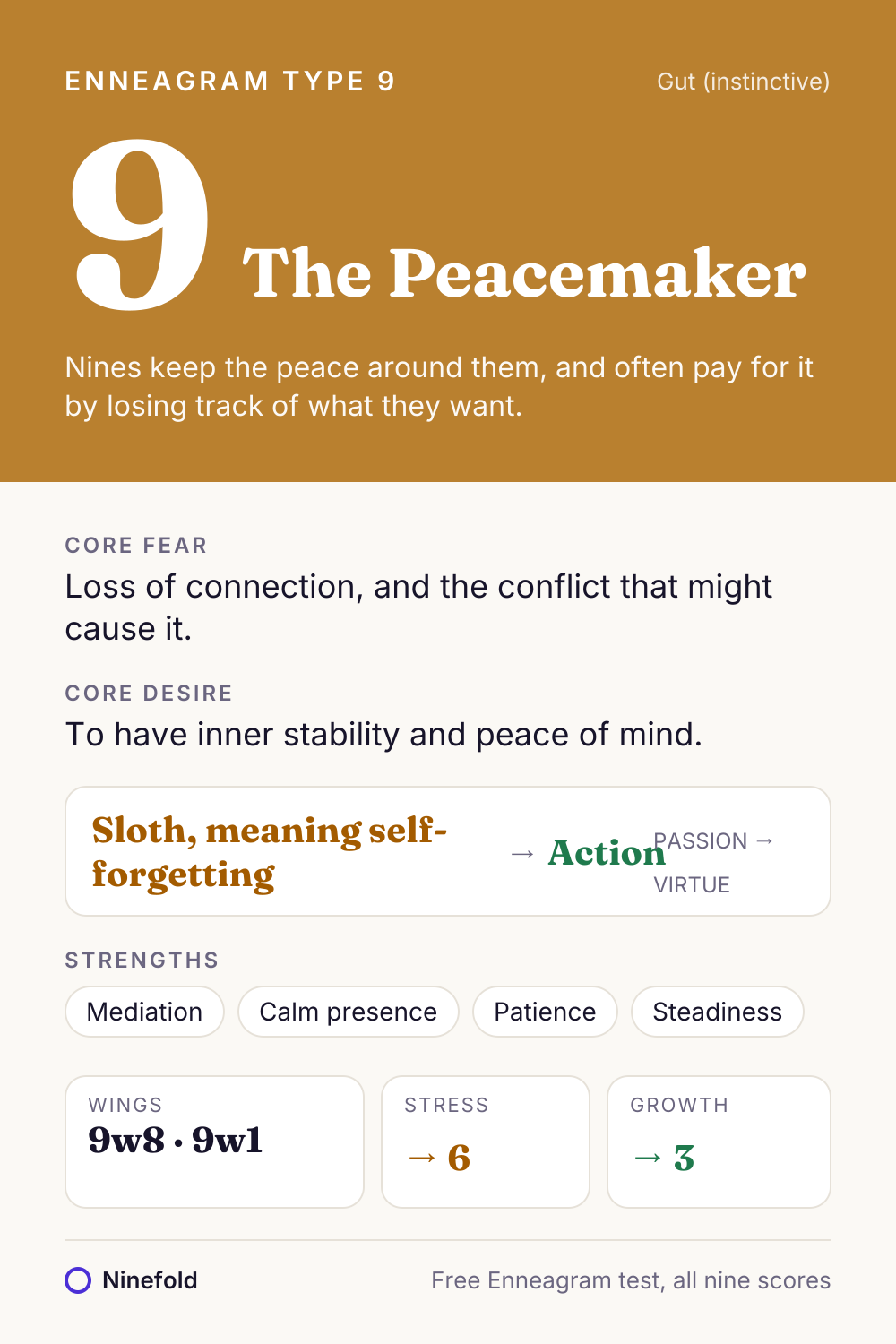
Type 9 sits at the top of the circle in the gut triad with 8 and 1, the three types whose core issue is anger and autonomy. An Eight expresses anger and a One channels it into correction, while a Nine falls asleep to it, so the energy goes into keeping life smooth and the anger leaks out as stubbornness.
That gives Nines a rare ability to see every side of a dispute and calm a room without effort. People relax around them. The cost is quieter: a Nine can merge with other people’s agendas until their own preferences fade, and the important task gets pushed behind ten small comfortable ones.
- Fixation
- Holy idea
- Defense mechanism
- Childhood pattern
Type 9 at a glance
Am I a Type 9? A 2-minute check
Ten statements from our full test: five that measure Type 9 and five from the types most often confused with it (2, 5, 4). Rate each from 1 (not me) to 5 (very me).
I go along with others to keep the peace.
Not meVery meI sense what other people need before they say it.
Not meVery meI can see every side of a disagreement.
Not meVery mePeople often come to me with their problems.
Not meVery meI lose track of my own priorities when other people want things from me.
Not meVery meI prefer to understand something fully before I act on it.
Not meVery meI avoid conflict, even when something bothers me.
Not meVery meEmotional demands from other people can leave me drained.
Not meVery meComfortable routines help me feel settled.
Not meVery meBeing ordinary, or just like everyone else, bothers me.
Not meVery me
Type 9 strengths and struggles
Strengths
- Mediation: they see every side of a dispute and help people find common ground.
- Calm presence: people relax around them and feel accepted as they are.
- Patience: they give people and processes time to unfold.
- Steadiness: in a tense team they are the one who keeps things even.
- Inclusion: they notice who has been left out and bring them in.
Struggles
- Procrastination: putting off the important task while finishing several small, comfortable ones.
- Self-forgetting: losing track of what they want until they cannot answer the question.
- Conflict avoidance: smoothing things over until a small problem has become a big one.
- Passive resistance: saying yes, then quietly digging in and not doing it.
- Numbing out: zoning out with screens, food or routine when life asks too much.
Signs you might be a Type 9
- You can explain both sides of an argument better than the people having it.
- When asked what you want, your honest answer is often "I don’t mind".
- You put off the one task that matters while finishing several that do not.
- People tell you that you are easy to be around.
- You go quiet and dig in when pushed, and others call it stubbornness.
- Routines and familiar places help you feel settled.
- You realise you were angry about something days after it happened.
- Conflict in the room makes you want to leave or smooth it over, even when it is not about you.
Type 9 wings: 9w8 and 9w1
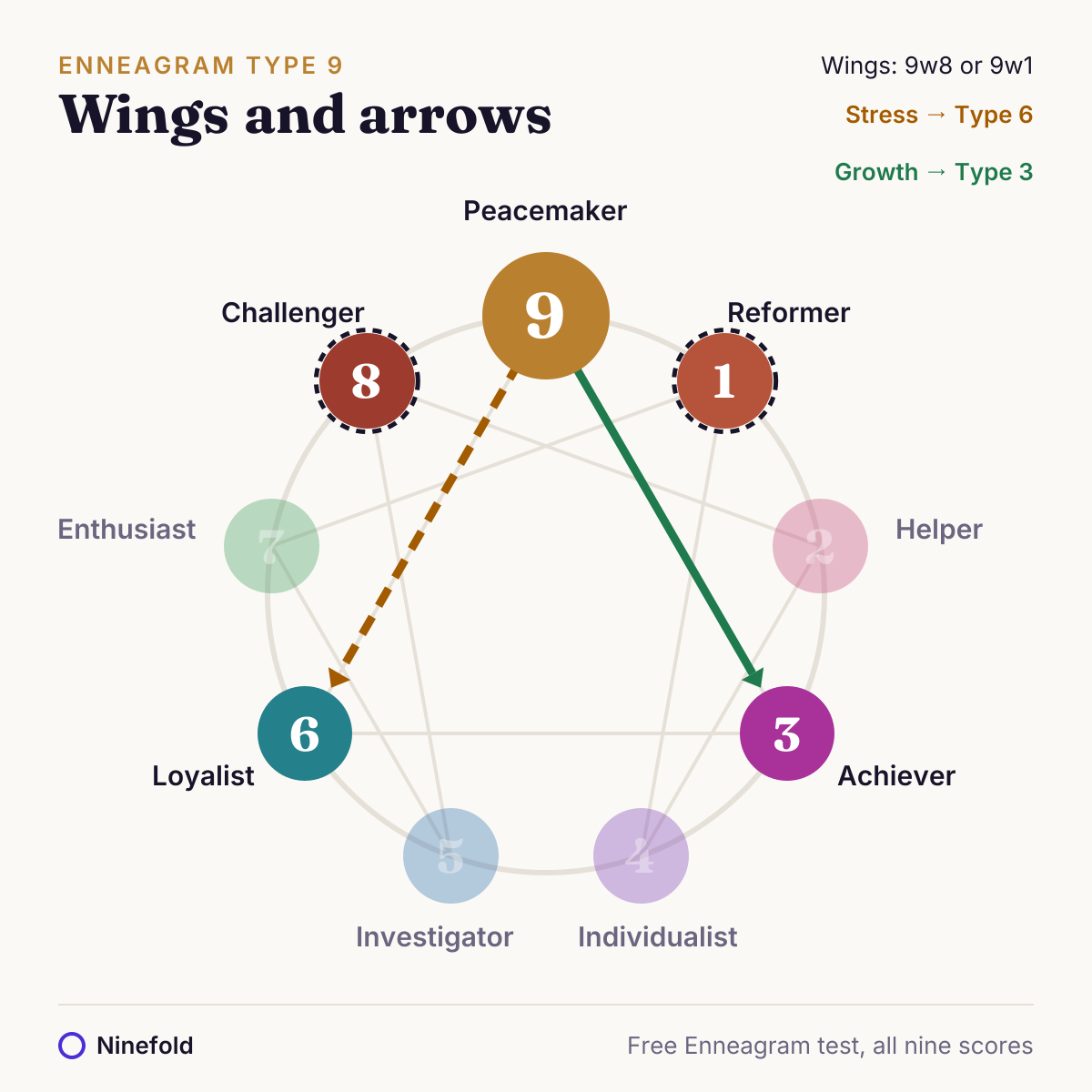
A wing is one of the two types next to yours on the circle. Most people lean toward one of them, and it colours how the core type shows up. Type 9’s neighbours are Type 8 and Type 1.
9w8, the Referee
The Eight wing adds grounded strength and a readier temper. 9w8s are warm, practical and more assertive than other Nines, and they can hold their ground when something matters to them. The risk is swinging between long stretches of easygoing calm and sudden flashes of anger that surprise everyone, including them.
9w1, the Dreamer
The One wing adds ideals and a quiet sense of how things should be. 9w1s are gentle, principled and orderly, often drawn to causes, nature or contemplative work. The risk is a polite detachment, holding high standards in private while avoiding the confrontation it would take to act on them.
| 9w8 | 9w1 | |
|---|---|---|
| Core drive | Keep the peace and keep their own ground | Keep the peace and keep things as they should be |
| Social energy | Warm, earthy, sociable in a relaxed way | Gentle, reserved, polite |
| Handling conflict | Avoids it, then stands firm or flares up | Avoids it and holds a quiet, principled disapproval |
| At work | Practical, steady, good at hands-on tasks | Orderly, conscientious, drawn to meaningful causes |
| In love | Easygoing and physical, protective when it counts | Idealistic and devoted, with private expectations |
| Under stress | Stubborn, then sudden flashes of anger | Critical in private, withdrawn in public |
| Growth edge | Say the anger while it is still small | Act on their ideals in the open |
9w8 or 9w1? Pick the truer statement in each pair.
0 of 6 picked.
The three Type 9 subtypes
Each type comes in three versions, depending on which instinct leads: self-preservation (safety and resources), social (belonging and standing) or one-to-one (intensity with one person). The subtype often changes how the type looks more than the wing does.
Self-preservation Nine: appetite
Self-forgetting through physical comfort and routine. Self-preservation Nines find peace in eating, sleeping, reading, games and familiar rituals, and those activities take the place of connection with their own deeper wants. They are practical, down to earth and can be quite stubborn about their routines.
Social Nine: participation
The countertype, the Nine that looks least like a Nine. Social Nines merge with groups and work hard to belong to them, so they can be busy, sociable and even workaholic. Their self-forgetting shows in how much they do for the group while their own needs stay unspoken, which is why they often mistype as Threes, Twos or Sevens.
One-to-one (sexual) Nine: fusion
Self-forgetting through merging with a partner or a few close people. One-to-one Nines take on the views, moods and interests of the person they are close to, and they can lose track of where they end and the other person begins. They are sweet, gentle and attentive, and they can mistype as Twos or Fours.
Which instinct leads? Rate each statement.
- Not meVery me
- Not meVery me
- Not meVery me
Move all three sliders to see your lead instinct.
Type 9 in stress and growth
Stress: toward Type 6
Under stress a Nine moves toward the average side of Six: they become anxious, worried and reactive, second-guess themselves and look to others for reassurance about decisions they have avoided.
Growth: toward Type 3
In growth a Nine takes on the healthy side of Three: energised, focused and willing to invest in their own goals. They name what they want, act on it and find that being visible does not cost them their connections.
What stress looks like
Type 9 → Type 6
- Worries about decisions they have been avoiding
- Asks others for reassurance again and again
- Gets defensive and suspicious in a way that surprises people
- Imagines everything that could go wrong
What growth looks like
Type 9 → Type 3
- Names one goal and takes visible steps toward it
- Says what they want early in a conversation
- Uses energy on their own priorities first
- Finds that being seen does not cost them their connections
Type 9 levels of development
The same type looks very different at its best and at its worst. The nine levels describe that range, from free and self-aware at level 1 to stuck and self-defeating at level 9. Stress, sleep and circumstance move people up and down the levels, so read them as a range you occupy.
- Level 1: Fully present and self-possessed. At peace with themself, they bring people together and stay engaged in their own life.
- Level 2: Receptive, patient and accepting. Others feel heard and calm in their company.
- Level 3: A natural mediator who unites people, keeps things steady and supports others in practical ways.
- Level 4: Starts to accommodate. Goes along with others to avoid friction and stops voicing their own views.
- Level 5: Disengaged. Tunes out problems, gets complacent and fills time with comfortable routines.
- Level 6: Minimises problems and resists change. Passive-aggressive stubbornness replaces open disagreement.
- Level 7: Neglectful and helpless, unable to face problems and unwilling to let anyone push them.
- Level 8: Numb and dissociated, cut off from their own life and the people in it.
- Level 9: Shuts down completely, as if they have disappeared from their own life. Professional help is needed at this level.
Type 9 or another type? The common mistypes
Type 9 vs Type 2
Both are warm, accommodating and attentive to others. A Two moves toward people to be needed and is aware of the help they give. A Nine goes along with people to avoid friction and is often unaware of their own wishes. If you help because it makes you valued, you lean Two; if you agree because conflict feels worse than giving in, you lean Nine.
Type 9 vs Type 5
Both can be quiet, withdrawn and low-key. A Five withdraws to think and to protect limited energy, and stays sharply engaged in the mind. A Nine withdraws into comfort and routine, and the attention goes vague. Ask whether your retreat is busy with ideas or restful and blank.
Type 9 vs Type 4
Both can seem dreamy and inward. A Four amplifies feelings and knows exactly what is missing. A Nine dampens feelings and struggles to know what they want at all. If you would rather feel intensely, you lean Four; if you would rather feel settled, you lean Nine.
Check yourself in under a minute:
Type 9 at work: careers that fit and jobs to avoid
Nines are strong wherever cooperation matters: mediation, HR, counselling, customer support, diplomacy, team leadership and any role that holds different people together. They are often the colleague who calms a tense meeting and makes everyone feel their view was considered.
They struggle with high-conflict cultures and with self-directed work that has no external deadline. A manager gets the most from a Nine by asking for their opinion directly and waiting for the answer, setting clear priorities and deadlines, and checking in on progress without pressure that triggers digging in.
Mediator, HR or employee relations
Counsellor, therapist or social worker
Customer support or account manager
Diplomat or community organiser
Librarian, archivist or researcher
Gardener, landscape or environmental work
Jobs that tend to drain a Four
What a Four needs from a job
Type 9 in relationships: compatibility with every type
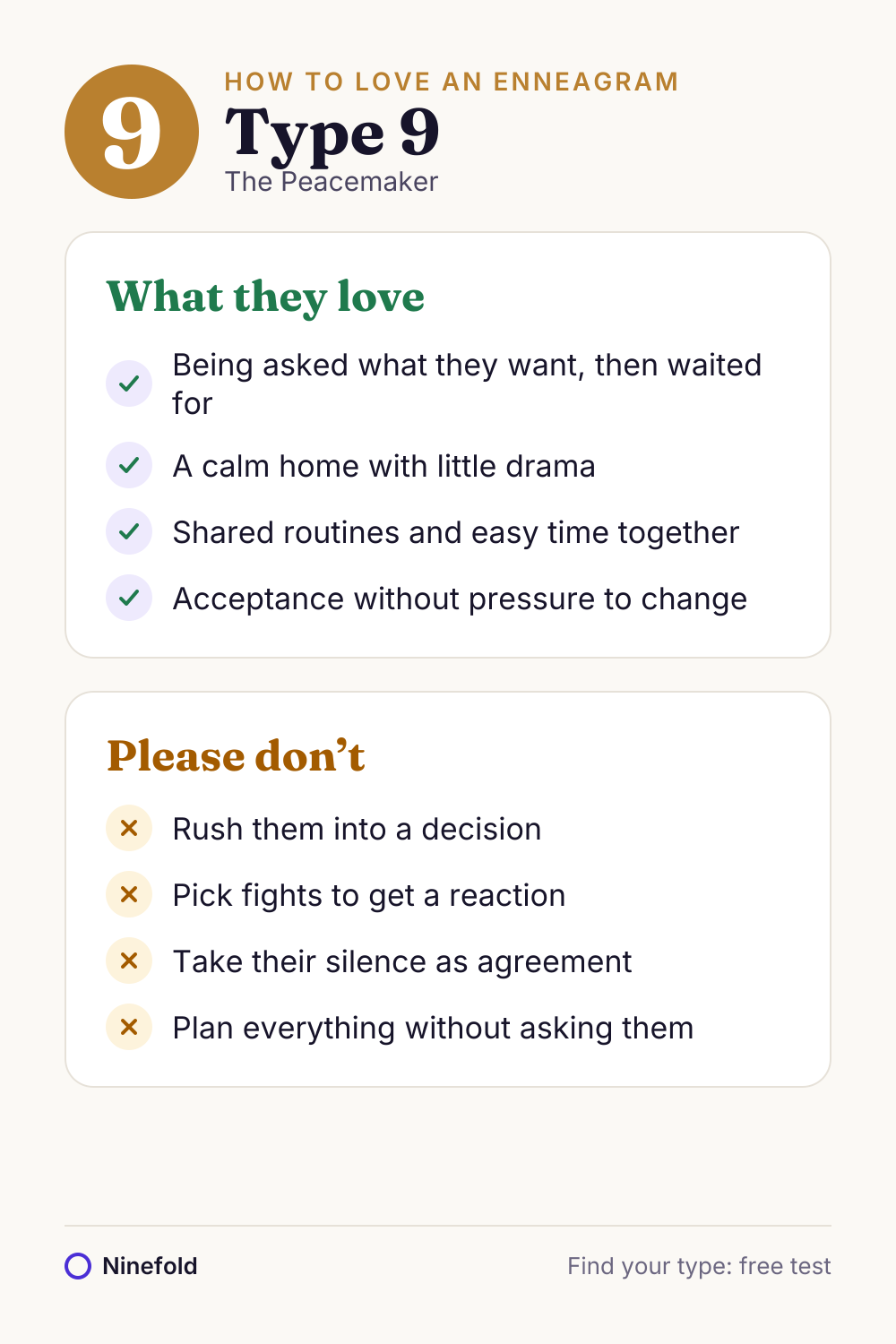
In relationships Nines bring acceptance, patience and an easy presence. A partner feels unjudged and supported, and conflict rarely escalates on the Nine’s side.
The common trap is merging: adopting the partner’s plans, friends and tastes until the Nine is hard to find, then resisting passively when something feels wrong. Partners help by asking what the Nine wants and waiting through the pause, and Nines help by voicing a preference early, while it is still small.
Type 9 and Type 1: The Reformer
Neighbours (wing)Type 9 and Type 2: The Helper
Across the circleType 9 and Type 3: The Achiever
Connected by an arrowType 9 and Type 4: The Individualist
Across the circleType 9 and Type 5: The Investigator
Across the circleType 9 and Type 6: The Loyalist
Connected by an arrowType 9 and Type 7: The Enthusiast
Across the circleType 9 and Type 8: The Challenger
Neighbours (wing)Type 9 and Type 9: The Peacemaker
Same typeSee how Type 9 pairs with each of the other eight on the Enneagram compatibility chart.
How Type 9 grows
- Each morning, name the one task that matters most and do it before anything comfortable.
- When you say "I don’t mind", follow it with one preference, however small.
- Notice where you feel irritation in your body. It is often the first sign of a want you have not said.
- Treat a disagreement as information about the relationship. Stating your view gives the other person something to connect with.
- Move your body daily. Physical energy makes it easier to act on what you want.
A 7-day practice
What the Enneagram schools say about Type 9
The four main schools teach the same type with different emphasis. Where they disagree, this page follows the majority and names the exception.
| Topic | Where the schools agree | Where they differ |
|---|---|---|
| Name | Every school builds Type 9 around peace, harmony and self-forgetting. | Riso and Hudson call it the Peacemaker; Palmer and the Narrative tradition use the Mediator; other teachers say the Harmoniser. |
| Passion and virtue | Sloth as the passion and action as the virtue, a pairing that goes back to Ichazo and runs through Naranjo, Palmer and Chestnut. | Naranjo and Chestnut read sloth as laziness about one’s own inner life, which can sit alongside heavy outer activity. Riso and Hudson put more weight on the desire for inner peace as the driver. |
| Stress and growth | The lines run to Six and to Three. | Riso and Hudson read them as stress toward Six and growth toward Three. Palmer calls Three the security point, where a Nine goes when it feels safe. Chestnut teaches growth through the stress point as well: a Nine grows by facing the fears of Six, then taking the action of Three. |
| Subtypes | Three instinctual versions of the type exist: self-preservation, social and one-to-one. | Naranjo and Chestnut give each subtype a name and a countertype (social Nine). Riso and Hudson describe instinct stackings without the countertype idea. |
| Levels of development | Health changes how a type looks more than the type itself. | The nine-level scale is Riso and Hudson’s; other schools describe health in broader bands or not at all. |
- Riso, D. R., and Hudson, R. (1999). The Wisdom of the Enneagram. Bantam. ISBN 0553378201.
- Naranjo, C. (1994). Character and Neurosis. Gateways. ISBN 9780895560667.
- Palmer, H. (1988). The Enneagram. HarperSanFrancisco. ISBN 9780062506832.
- Chestnut, B. (2013). The Complete Enneagram. She Writes Press. ISBN 9781938314551.
Type 9 FAQ
What is an Enneagram type 9?
Type 9, often called the Peacemaker, is the personality pattern built around harmony and inner stability. Nines are accepting, patient and easygoing, and their core fear is loss of connection and the conflict that might cause it.
What is the difference between 9w8 and 9w1?
9w8 is more grounded, practical and assertive, and will hold their ground when something matters. 9w1 is more idealistic, orderly and reserved, and keeps their standards to themselves.
Where does a type 9 go in stress and growth?
In stress a Nine moves toward Six and becomes anxious, worried and reactive. In growth a Nine moves toward Three and becomes energised, focused and invested in their own goals.
What types are most often confused with type 9?
Types 2, 5 and 4. Twos are also accommodating but want to be needed, Fives also withdraw but stay mentally busy, and Fours also look dreamy but amplify their feelings. The check on this page asks you to pick between their core motives.
How rare is Enneagram type 9?
No representative population study exists, so any percentage you see is a count of people who took one website’s test. Nines often see themselves in several types, which makes self-reported counts less reliable still. Treat rarity claims as marketing.
Are type 9s lazy?
No. The classic passion is called sloth, and it means laziness about their own priorities. Many Nines work long hours for others, and social Nines can be workaholics, while the task that matters to them keeps slipping.
What are the type 9 subtypes?
Self-preservation Nines (appetite) settle into comfort and routine; social Nines (participation) work hard to belong to groups and are the countertype; one-to-one Nines (fusion) merge with a partner’s views and moods. The check on this page shows which instinct leads for you.
What jobs should a type 9 avoid?
Roles built on constant confrontation or no structure: cut-throat sales, high-conflict litigation, politically charged teams and self-directed work with no deadlines. Nines do their best work with clear priorities and a calm team.
Who is the best match for an Enneagram 9?
No type is a guaranteed match. Nines do best with partners who ask what they want and wait for the answer. Threes, on Nine’s growth line, often bring the drive that helps a Nine act on their own goals.
Is there an MBTI type for Enneagram 9?
No fixed one. The MBTI sorts how you take in information and decide; the Enneagram sorts what motivates you. Nines are often linked with INFP and ISFP because those types also value harmony and go with the flow, and a Nine can still be any MBTI type.
Which famous people are Enneagram type 9?
Typing a public figure means guessing their private motives, so every list online is speculation. We do not publish one. The self-check on this page is a better guide to whether you are a Nine than any celebrity comparison.