Type 4 in brief
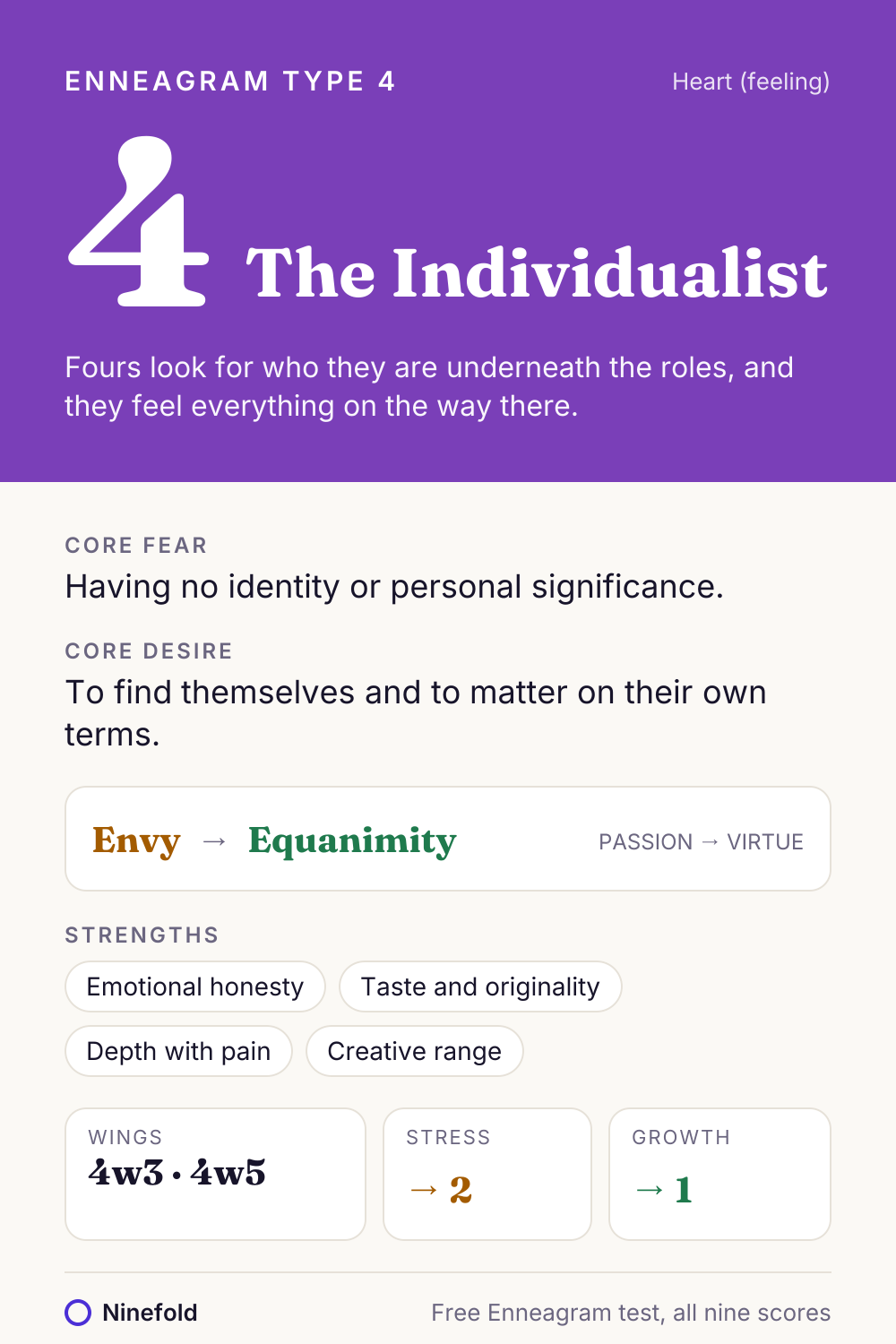
Type 4 sits in the heart triad with 2 and 3, the three types whose core issue is identity and image. Where a 2 looks for worth in being needed and a 3 in being admired, a 4 turns inward and asks whether the self underneath is genuine and whether it is enough.
That question gives Fours their range. They notice emotional detail other people skip, they are honest about pain, and they have little patience for small talk that hides what is going on. The same focus makes them compare: the gap between what they feel and what others seem to have can become the main thing they see.
- Fixation
- Holy idea
- Defense mechanism
- Childhood pattern
Type 4 at a glance
Am I a Type 4? A 2-minute check
Ten statements from our full test: five that measure Type 4 and five from the types most often confused with it (5, 9, 6). Rate each from 1 (not me) to 5 (very me).
I often feel that something is missing in me that other people seem to have.
Not meVery meI need plenty of time alone to recharge.
Not meVery meI am drawn to beauty, melancholy and things with emotional depth.
Not meVery meI watch a situation from a distance before I join in.
Not meVery meBeing ordinary, or just like everyone else, bothers me.
Not meVery meI can see every side of a disagreement.
Not meVery meI spend a lot of time inside my own feelings.
Not meVery meComfortable routines help me feel settled.
Not meVery meI long for things I do not have, or for times that are gone.
Not meVery meI question authority, and I also want to be able to rely on it.
Not meVery me
Type 4 strengths and struggles
Strengths
- Emotional honesty: they will name the feeling in the room that everyone else is stepping around.
- Taste and originality: they notice the detail that makes something personal and refuse the generic version.
- Depth with pain: they can stay with grief, loss or confusion without rushing someone to feel better.
- Creative range: experience turns into work, whether that is writing, design, music or the way they set a table.
- Loyalty to what is true for them, even when it costs approval.
Struggles
- Comparison: the gap between what they feel and what others seem to have can become the only thing they see.
- Mood as a guide: waiting to feel ready before acting, which can stall work for weeks.
- Push and pull in love: idealising what is far away and finding fault in what is close.
- Feeling exempt: believing ordinary rules matter less because their suffering is greater.
- Withdrawal: going quiet to protect a hurt and leaving what they need unsaid.
Signs you might be a Type 4
- You feel most alive in conversations about meaning, loss or what someone wants from life.
- You have been told you are "too much" or "too sensitive", and you suspect the people saying it feel too little.
- You can name the exact song, light or season that fits a mood.
- Envy shows up as longing more often than resentment: you want the life someone else seems to have without effort.
- Routine and conformity drain you faster than hard work does.
- You return to old memories and replay them, sometimes for comfort and sometimes to feel the ache again.
- Being misunderstood bothers you more than being disliked.
- You would rather make something personal and imperfect than something polished and generic.
Type 4 wings: 4w3 and 4w5
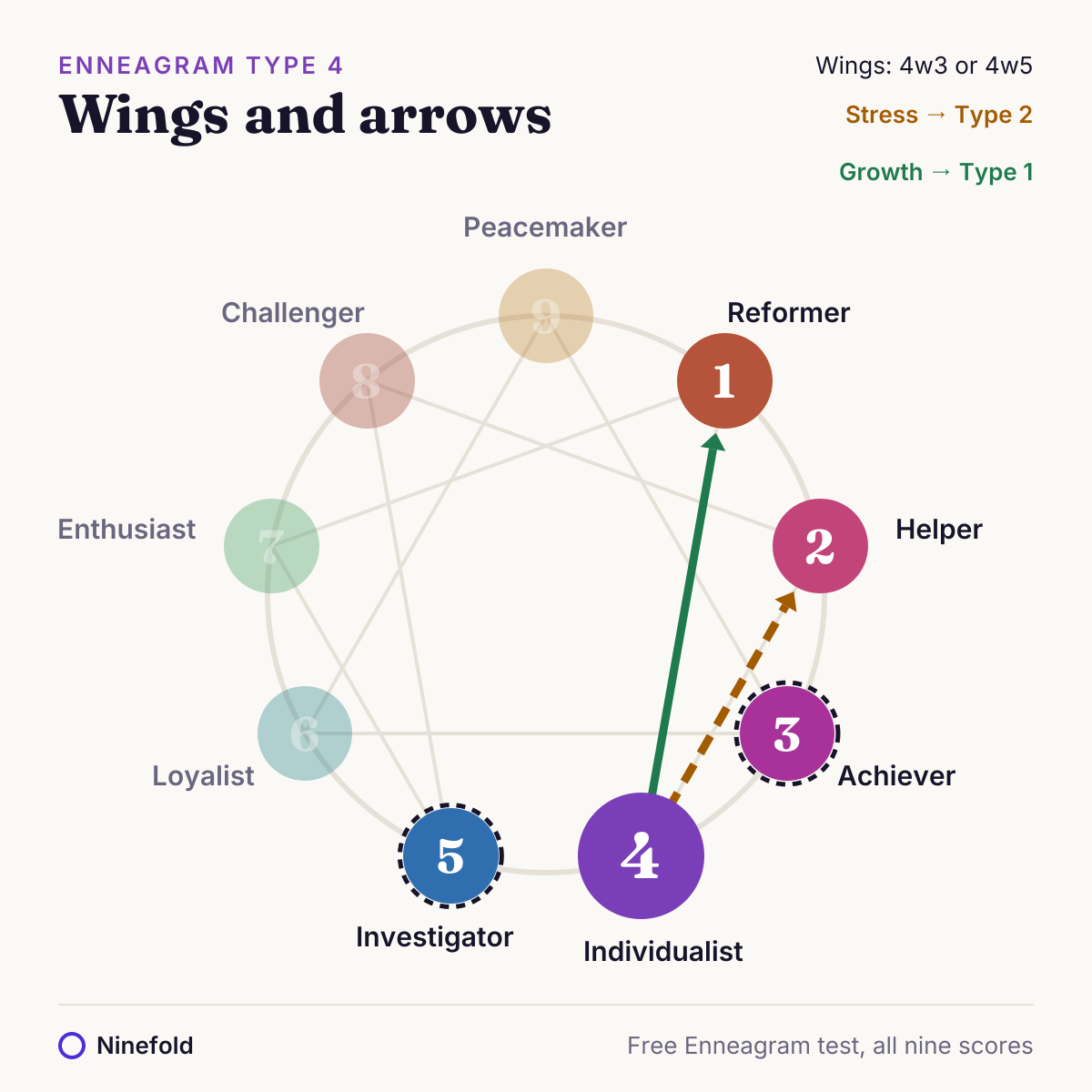
A wing is one of the two types next to yours on the circle. Most people lean toward one of them, and it colours how the core type shows up. Type 4’s neighbours are Type 3 and Type 5.
4w3, the Aristocrat
The Three wing adds drive and an eye for how things come across to an audience. 4w3s are more outgoing, more competitive and more willing to perform their individuality, often in visible creative work. The risk is a swing between grandiosity and shame when the work is not recognised.
4w5, the Bohemian
The Five wing pulls inward and toward ideas. 4w5s are quieter, more private and more original in an unconventional way, less interested in recognition than in getting the thing right for themselves. The risk is isolation: retreating so far into the inner world that the outer one stops getting attention.
| 4w3 | 4w5 | |
|---|---|---|
| Core drive | Be recognised for a distinct self | Understand and protect a distinct self |
| Social energy | Outgoing, expressive, reads the room | Private, reserved, needs long stretches alone |
| Creative style | Polished, made for an audience | Unconventional, made for themselves first |
| At work | Ambitious, competitive, image-aware | Independent, research-minded, resists deadlines that feel arbitrary |
| In love | Romantic, dramatic, wants to be chosen | Intense in private, slow to let someone in |
| Under stress | Swings between grandiosity and shame | Isolates and goes numb or bleak |
| Growth edge | Let the work matter more than how it is received | Stay connected when retreat feels safer |
4w3 or 4w5? Pick the truer statement in each pair.
0 of 6 picked.
The three Type 4 subtypes
Each type comes in three versions, depending on which instinct leads: self-preservation (safety and resources), social (belonging and standing) or one-to-one (intensity with one person). The subtype often changes how the type looks more than the wing does.
Self-preservation Four: tenacity
The countertype, the Four that looks least like a Four. Self-preservation Fours turn envy into effort: they suffer in silence, push through hardship, and would rather endure than complain. They can read as stoic, even cheerful, which is why they often mistype as One, Three or Six.
Social Four: shame
The most recognisable Four. Social Fours compare themselves to others and come out short, then feel the shame of it openly. They are sensitive to belonging, attracted to suffering as something that makes them understood, and can lean on it to be seen.
One-to-one (sexual) Four: competition
Envy turned outward. One-to-one Fours compete with the people they envy, express emotion loudly, and make demands when they feel shortchanged. They are passionate and intense, and they often mistype as Eight or Three.
Which instinct leads? Rate each statement.
- Not meVery me
- Not meVery me
- Not meVery me
Move all three sliders to see your lead instinct.
Type 4 in stress and growth
Stress: toward Type 2
Under stress a Four moves toward the average side of Two: they over-involve themselves with others, look for rescue, and can become clingy or manipulative about being needed, while still feeling that nobody understands them.
Growth: toward Type 1
In growth a Four takes on the healthy side of One: principled, disciplined and focused on doing the work in front of them. Feelings stop being the measure of everything and become one input among several, which is when Fours tend to produce their best work.
What stress looks like
Type 4 → Type 2
- Looks for reassurance and rescue, sometimes by over-helping to secure affection
- Says yes to keep someone close, then resents it
- Clings to a relationship while still feeling unseen inside it
- Uses being needed as proof of being loved
What growth looks like
Type 4 → Type 1
- Keeps a routine for the work they care about and shows up on low days
- Lets principles decide what happens today, whatever the mood
- Finishes things, accepts good enough, and moves to the next piece
- Treats a feeling as information to weigh, one input among several
Type 4 levels of development
The same type looks very different at its best and at its worst. The nine levels describe that range, from free and self-aware at level 1 to stuck and self-defeating at level 9. Stress, sleep and circumstance move people up and down the levels, so read them as a range you occupy.
- Level 1: Renews themself through experience. Feeling turns into creation, and the self no longer needs proof.
- Level 2: Deeply self-aware and intuitive, honest about their inner life and gentle with other people’s.
- Level 3: Expressive and creative. Turns personal experience into something that helps others feel seen.
- Level 4: Starts to romanticise. Uses imagination and mood to heighten feelings and puts off acting on them.
- Level 5: Withdraws to protect the self-image. Moody, self-absorbed, feels different from everyone.
- Level 6: Self-indulgent and exempt from ordinary rules because they suffer more. Envy becomes open.
- Level 7: Alienated and inhibited, blocked creatively, angry at themself for wasting their life.
- Level 8: Clinically depressed, tormented by self-contempt and the gap between who they are and who they think they should be.
- Level 9: Despair. Feels that life has no meaning for them. Professional help is needed at this level.
Type 4 or another type? The common mistypes
Type 4 vs Type 5
Both withdraw and both value depth. A Five withdraws to think and to conserve energy, and feelings come later. A Four withdraws to feel, and the thinking serves the feeling. If you are protecting your energy, you lean Five; if you are protecting your identity, you lean Four.
Type 4 vs Type 9
Nines and Fours can both look withdrawn and dreamy. A Nine numbs feeling to keep the peace and forgets their own wants; a Four amplifies feeling and knows exactly what is missing. Ask whether you go quiet to avoid friction or because the feeling is too big to share.
Type 4 vs Type 6
Both can be anxious, reactive and suspicious of easy answers. A Six worries about safety and support and looks outward for what could go wrong; a Four worries about identity and looks inward for what is missing. The Six asks "can I trust this?", the Four asks "is this me?".
Check yourself in under a minute:
Type 4 at work: careers that fit and jobs to avoid
Fours do their best work when the role has room for judgement and personal style: design, writing, therapy, research with a human angle, any craft where taste matters. They are often the person who notices the emotional subtext in a meeting.
They struggle with roles that reward conformity or volume. A manager gets more from a Four by explaining why the work matters than by setting targets, and by giving direct feedback in private.
Writer, editor or content designer
Therapist, counsellor or coach
Designer (brand, product, interior)
Musician, artist or photographer
Qualitative researcher or UX researcher
Hospice, palliative or grief care
Jobs that tend to drain a Four
What a Four needs from a job
Type 4 in relationships: compatibility with every type
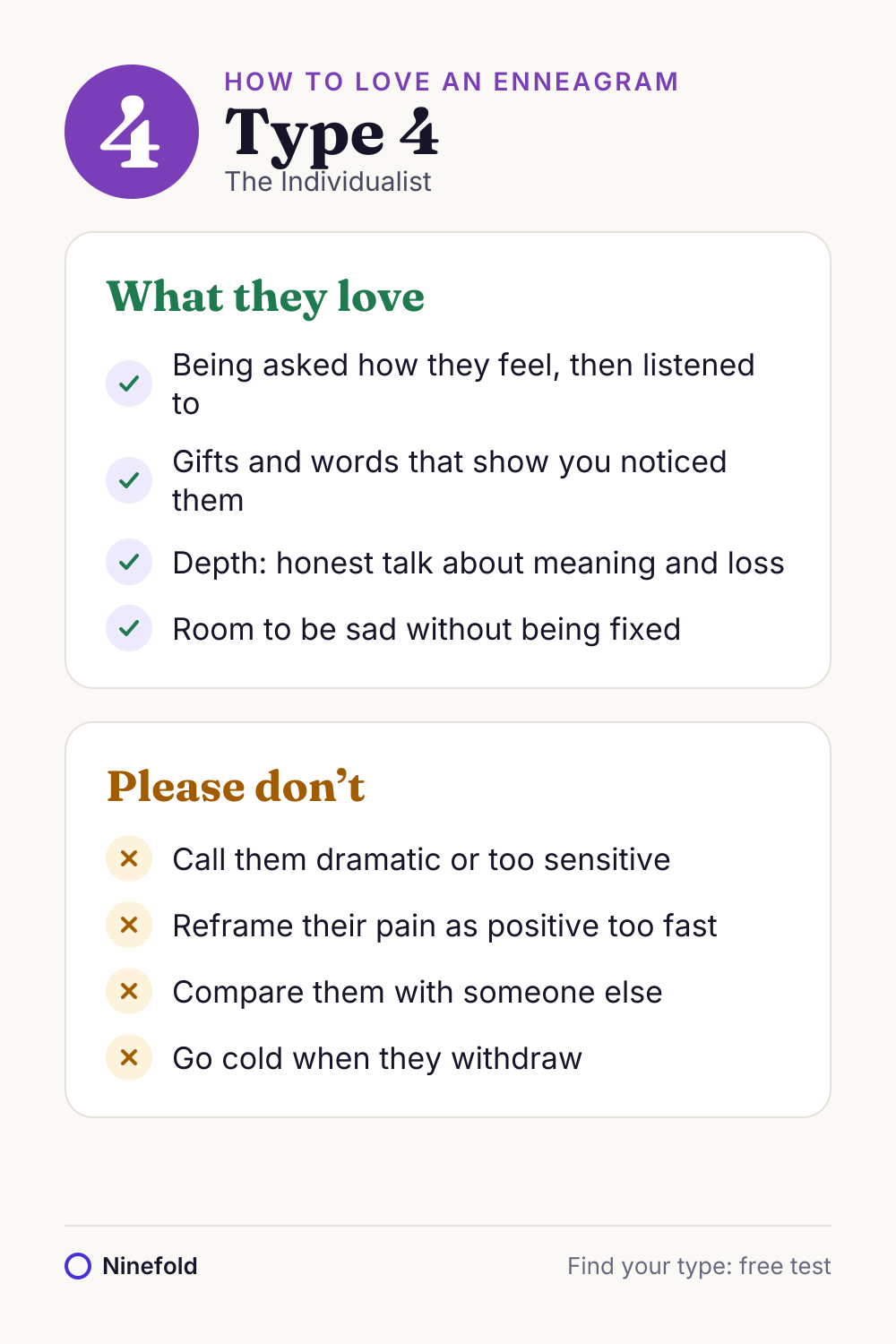
In relationships Fours bring intensity, attention and a refusal to keep things on the surface. Being known matters more to them than being admired, and they notice when a partner is only half there.
The common trap is push and pull: idealising someone while they are out of reach, then finding fault once they are close. Partners help by staying steady through moods without trying to fix them, and Fours help by naming what they need out loud.
Type 4 and Type 1: The Reformer
Connected by an arrowType 4 and Type 2: The Helper
Connected by an arrowType 4 and Type 3: The Achiever
Neighbours (wing)Type 4 and Type 4: The Individualist
Same typeType 4 and Type 5: The Investigator
Neighbours (wing)Type 4 and Type 6: The Loyalist
Across the circleType 4 and Type 7: The Enthusiast
Across the circleType 4 and Type 8: The Challenger
Across the circleType 4 and Type 9: The Peacemaker
Across the circleSee how Type 4 pairs with each of the other eight on the Enneagram compatibility chart.
How Type 4 grows
- Act before the feeling is right. Write the page, send the message, then notice that the mood followed the action.
- When envy shows up, name the specific thing you want and take one step toward it.
- Keep a short list of what is already good and present, to balance the habit of noticing what is missing.
- Build a routine around the work you care about. Structure protects creativity from moods.
- Let people see the ordinary parts of you too. Being ordinary sometimes does not erase you.
A 7-day practice
What the Enneagram schools say about Type 4
The four main schools teach the same type with different emphasis. Where they disagree, this page follows the majority and names the exception.
| Topic | Where the schools agree | Where they differ |
|---|---|---|
| Name | Every school builds Type 4 around identity, authenticity and longing. | Riso and Hudson call it the Individualist; Palmer and the Narrative tradition use the Romantic; other teachers say the Artist or the Intense Creative. |
| Passion and virtue | Envy as the passion and equanimity as the virtue, a pairing that goes back to Ichazo and runs through Naranjo, Palmer and Chestnut. | Riso and Hudson put more weight on the self-image ("I am unique") than on envy as the driver. |
| Stress and growth | The lines run to Two and to One. | Riso and Hudson read them as stress toward Two and growth toward One. Palmer calls One the security point, where a Four goes when it feels safe. Chestnut teaches growth through the stress point: a Four grows by moving ahead to the healthy side of Two and back to One to reclaim discipline. |
| Subtypes | Three instinctual versions of the type exist: self-preservation, social and one-to-one. | Naranjo and Chestnut give each subtype a name and a countertype (self-preservation Four). Riso and Hudson describe instinct stackings without the countertype idea. |
| Levels of development | Health changes how a type looks more than the type itself. | The nine-level scale is Riso and Hudson’s; other schools describe health in broader bands or not at all. |
- Riso, D. R., and Hudson, R. (1999). The Wisdom of the Enneagram. Bantam. ISBN 0553378201.
- Naranjo, C. (1994). Character and Neurosis. Gateways. ISBN 9780895560667.
- Palmer, H. (1988). The Enneagram. HarperSanFrancisco. ISBN 9780062506832.
- Chestnut, B. (2013). The Complete Enneagram. She Writes Press. ISBN 9781938314551.
Type 4 FAQ
What is an Enneagram type 4?
Type 4, often called the Individualist, is the personality pattern built around finding and expressing an authentic identity. Fours are emotionally honest, creative and introspective, and their core fear is having no identity or personal significance.
What is the difference between 4w3 and 4w5?
4w3 is more outgoing, ambitious and image-aware, and tends to put their individuality on display. 4w5 is more private, cerebral and unconventional, and tends to keep their inner world to themselves.
Where does a type 4 go in stress and growth?
In stress a Four moves toward Two and becomes clingy or over-involved with others. In growth a Four moves toward One and becomes principled, disciplined and focused on doing the work.
What types are most often confused with type 4?
Types 5, 9 and 6. Fives also withdraw but to think and conserve energy, Nines also look dreamy but numb their feelings, and Sixes also worry, though about safety and support. The check on this page asks you to pick between their core motives.
How rare is Enneagram type 4?
No representative population study exists, so any percentage you see is a count of people who took one website’s test, and Fours are more likely than most types to take personality tests at all. Treat rarity claims as marketing.
Are type 4s narcissists?
No. Narcissistic personality disorder is a clinical diagnosis, and no study links it to any Enneagram type. Fours can be self-absorbed, and at unhealthy levels they can feel exempt from ordinary rules, but at their most typical they are more likely to feel deficient than superior.
Who are Enneagram 4s attracted to?
Fours tend to be drawn to people who seem to have something they feel they lack, often someone a little out of reach. What helps a Four stay in a relationship is a partner who stays steady through moods and is honest about their own feelings.
What jobs should a type 4 avoid?
Roles with no room for judgement or personal style: scripted high-volume sales, repetitive admin, work judged only on quotas, and rigid compliance roles. Fours do their best work when the reason behind the work is clear.
What are the type 4 subtypes?
Self-preservation Fours (tenacity) endure pain quietly and are the countertype; social Fours (shame) compare themselves to others and feel it openly; one-to-one Fours (competition) turn envy outward and compete. The check on this page shows which instinct leads for you.
Is there an MBTI type for Enneagram 4?
No fixed one. The MBTI sorts how you take in information and decide; the Enneagram sorts what motivates you. Fours are often linked with INFP and INFJ because those types also centre on inner values and meaning, and a Four can still be any MBTI type.
Which famous people are Enneagram type 4?
Typing a public figure means guessing their private motives, so every list online is speculation. We do not publish one. The self-check on this page is a better guide to whether you are a Four than any celebrity comparison.